
Where the Lights End, Silence Begins
The Slow Travel Perspective
In Ngaduman, slow travel begins when night gives us time to see life from a distance—and then look back at the life close to us. From a villager’s terrace, city lights shimmer beyond the line of the hills, while within it there are only homes, gardens, trees, wind, and conversations around a fire. Slowly, the boundary between a busy world and a quiet life begins to reveal itself.
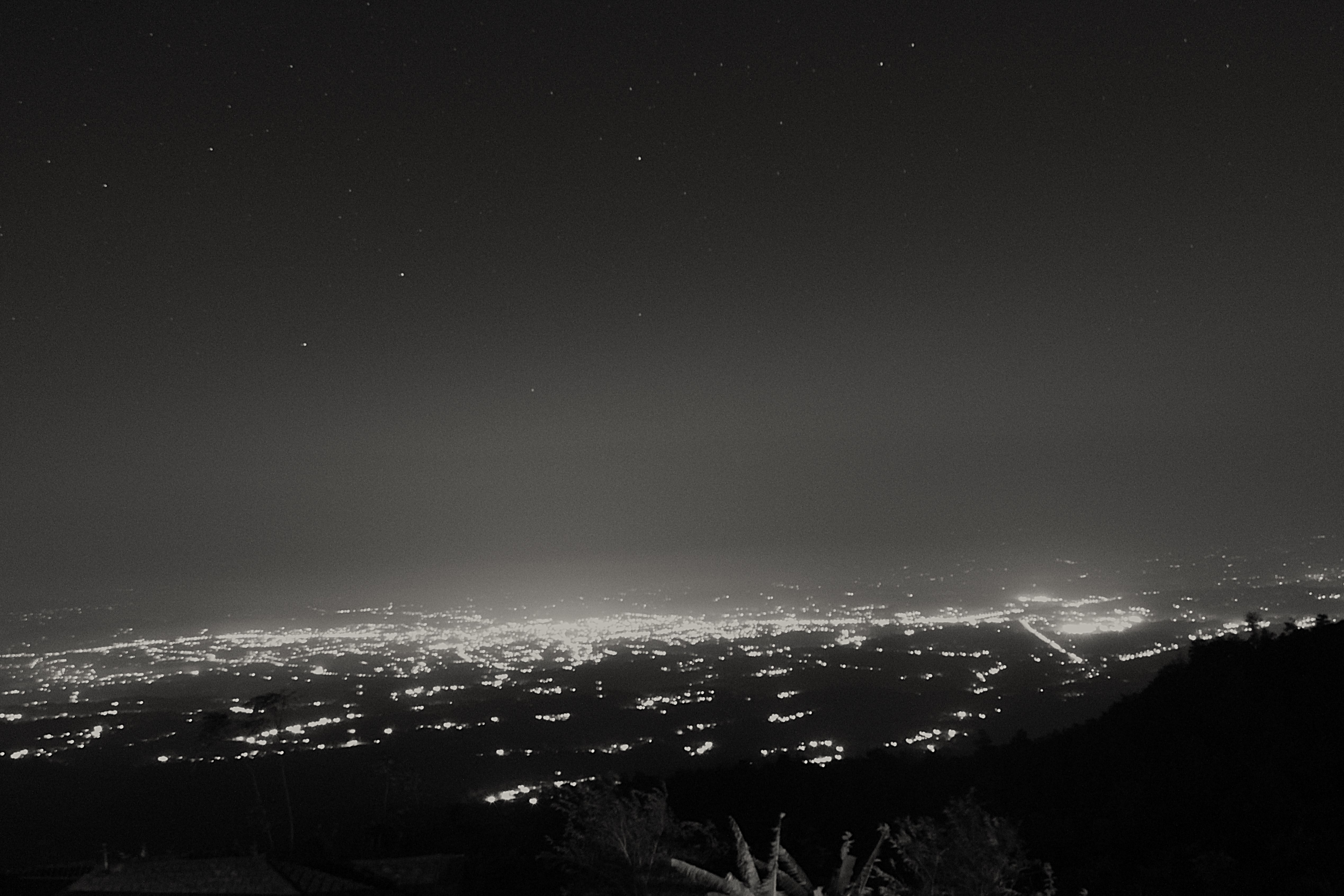
Standing on the terrace of a villager’s home in Ngaduman at night, your eyes settle on the line of a hillside.
It looks almost like a boundary.
Inside it, Ngaduman lies quietly in the darkness. A few plants, including rows of banana trees with their leaves partly visible, emerge from the shadows.
Beyond it, thousands of lights shimmer in the distance.
Some are bright. Others appear only as tiny points of light. The lights form long, symmetrical lines before turning left and right, as if tracing the roads that carry life somewhere beyond the hills.
At one point, brighter lights gather together without forming a line.
Perhaps that is where a city centre lies. Salatiga, perhaps. Or Semarang.
We cannot be certain.
What we do know is that, on this night, we are standing between two worlds.
On the darker side of that line, the people of Ngaduman continue their evening in a simple way.
As activities outside begin to settle, life moves into the traditional kitchen.
Firewood becomes the source of warmth. Neighbours come by and sit together around the fire. There is no meeting table. No special room for gathering.
Only fire, warmth, and conversation.
Their conversations move naturally from the condition of vegetables in the fields, to their coffee plants, to their livestock.
One person shares an experience. Another listens.
Then the experience is discussed, exchanged, and slowly becomes new knowledge.
Life in Ngaduman does not end when the sun goes down.
It simply changes form. During the day, life meets the fields, Arabica coffee plants, livestock, and the work that needs to be done.
At night, the experiences from all of these things are brought into the kitchen.
The fire becomes a gathering point. Conversation becomes a place for sharing.
What one person has experienced in the field can become knowledge for another. From there, new thoughts and fresh ideas emerge to help them respond to the challenges they face.
At around 1,800 metres above sea level, this life unfolds beneath a roof far greater than any house.
Mount Merbabu. The hills. The forest.
The coffee gardens. And the night sky.
From the terrace, the contrast becomes unmistakable.
On one side of the hillside, lights trace long roads towards the bustle of the world beyond.
On the other, Ngaduman embraces the darkness. Not an empty darkness.
The night wind moves through the pine forest, sounding almost like wind created in a recording studio. A villager’s dog barks from somewhere nearby. Now and then, voices rise as neighbours greet one another.
And above it all, stars scatter across the sky.
Some shine brightly. Others appear faint because they are so far away.
It is almost as if they are competing to show which light is more compelling: the artificial lights far below or the natural light above.
Here, we may begin to understand what quietcation means. Silence is not simply the absence of sound.
It is a space in which we become aware of where we are.
In Ngaduman, your face can turn towards the distant glow of the world below, while the cool night wind touches your skin and your head rests beneath a sky filled with its own natural lights.
Perhaps one evening, you will find yourself standing on the terrace of a villager’s home in Ngaduman.
You do not need to search for a view. Simply look at the line of the hill.
Watch how the lights begin where the darkness ends, while Ngaduman itself remains quiet within it.
Then listen to the wind. Listen to the dogs barking.
Listen to the voices of neighbours greeting one another.
And perhaps, after a while, you will realise that you are not simply looking at a landscape.
You are standing inside a way of life.
Sabato Kaliwuan opens the door for travellers to look more closely at the life unfolding beyond that line of hills.
Sabato Kaliwuan creates access not only to a place, but to the people and stories that give a place its meaning.
In Ngaduman, that access means having the chance to understand how the night is lived: how neighbours gather in the kitchen, share experiences about crops, coffee, and livestock, and turn everyday experience into shared knowledge.
Sabato Kaliwuan connects travellers with these quiet moments, allowing them to be encountered rather than simply observed.
Sabato Kaliwuan, A Delightful Companion for Your Journey.
More than a curated travel experience, Sabato Kaliwuan is your access to authentic villages, meaningful encounters, and local stories that reveal Central Java beyond sightseeing. Through conversations with the people who shape village life, every journey becomes an opportunity to understand how villages are adapting, preserving their heritage, and creating new futures.
Perhaps luxury does not always lie where the brightest lights are.
Sometimes, it begins where artificial light ends. At a line of hills. At a house looking towards the distant glow of a city.
In a kitchen warmed by a wood fire. Among the conversations of neighbours.
And beneath a sky that lights itself. In Ngaduman, we may arrive to see the night.
But slowly, the night may make us look again at the way we live.