
When the Sun Leaves, a Light Watches Over the Road
In Ngaduman, slow travel can be felt in the quiet transition from one rhythm of village life to another. The afternoon brings farmers home from their gardens, small street lights begin to glow, and night gradually draws families back into their homes. There is little to do but notice the change, as light, conversation, cool air, and everyday life slowly move towards evening.
Late afternoon, just before sunset.
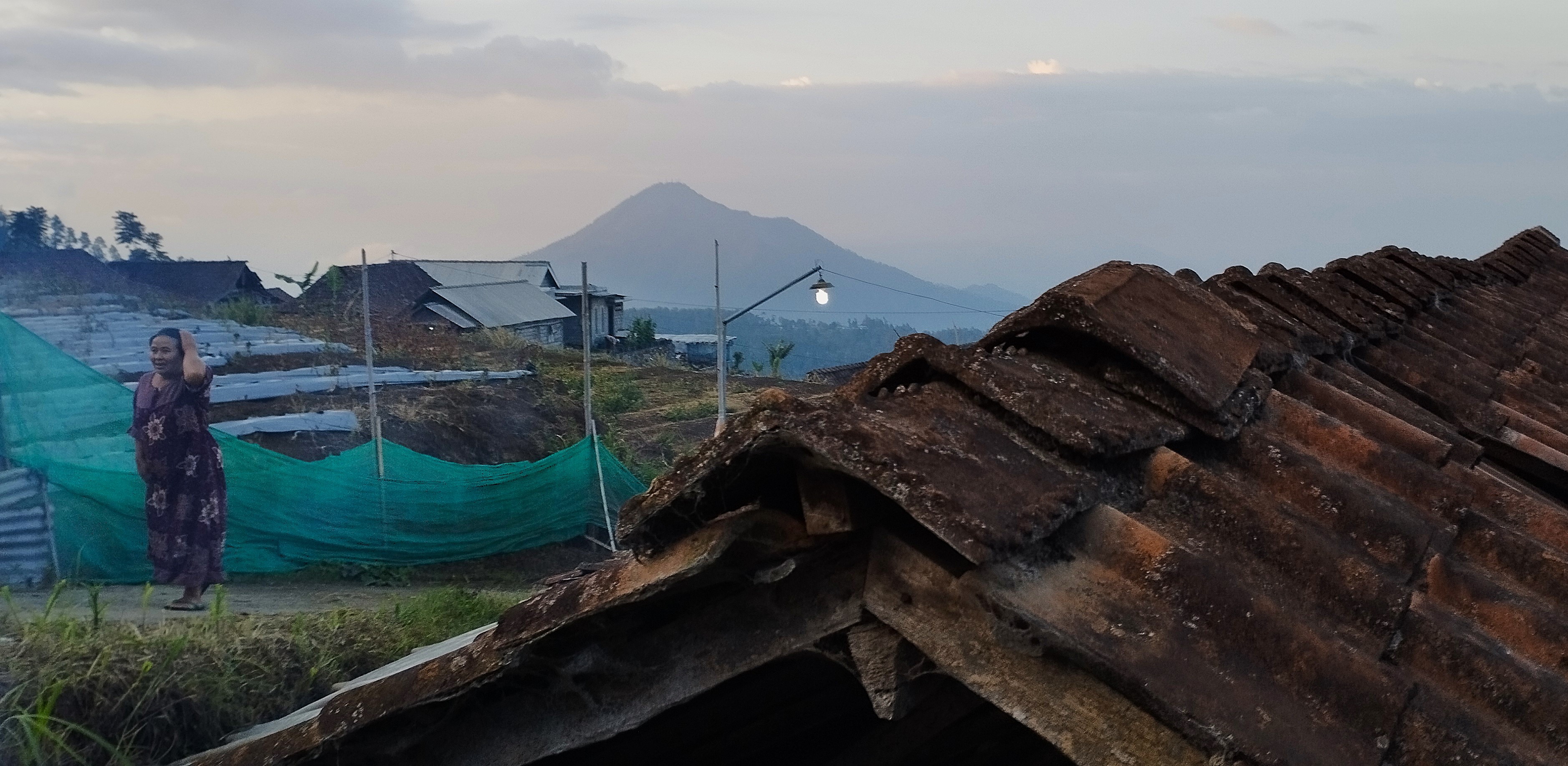
A street light comes on along the small road connecting farmers to their gardens. It seems to switch on a little early, as if already prepared to replace the sunlight that will soon disappear.
Above it, the sky remains clear and blue. The mountain rising firmly in the distance is still sharply visible.
Along the small road, a woman walks slowly. Her lips are slightly parted, as if she is speaking to someone some distance away, near a garden planted with young vegetable seedlings. Plastic mulch covers parts of the field.
Nearby, moss growing across the roof tiles of a house is beginning to dry.
These small details seem to speak of the cool air and high humidity that are part of everyday life in Ngaduman.
The woman continues walking as she talks.
There is nothing extraordinary about the conversation seen from a distance. Yet it is precisely these simple exchanges that give an afternoon in the village its character.
Behind her, the street light is already glowing.
Its white light resembles an eye quietly watching over the road, making sure that those passing along the small path can make their way safely.
Meanwhile, the mountain that still stands clearly beneath the blue sky will soon begin to disappear.
The sun sinks lower.
The light becomes thinner.
And soon, the mountain will no longer be visible.
As daylight begins to fade, the street lights take over.
The road connecting the villagers to their gardens is now illuminated by white light. Those still passing through can see the path ahead, while night slowly settles between the houses and gardens.
Before long, the villagers return to their homes.
The day's work in the gardens comes to an end.
Home becomes the next place where life continues.
Inside, families begin preparing dinner. In the kitchen, a wood fire provides warmth. The cool night air makes the kitchen a place to gather as well as a place to warm the body.
A day that began with activity in the gardens slowly comes to a close inside the home.
From sunlight to lamplight.
From the garden to the kitchen.
From work to the warmth of family.
Perhaps a village does not always need to be understood through something grand.
Sometimes, the character of a place is revealed through small changes unfolding within a few minutes.
A woman walking and talking.
Vegetable seedlings growing beneath plastic mulch.
Moss slowly drying on roof tiles.
A mountain that was once clearly visible gradually disappearing with the evening light.
Then, a light comes on.
Not simply to illuminate the road, but to mark the moment when one part of the day gives way to another.
In Ngaduman, life does not stop when the sun goes down.
It simply moves somewhere else.
From the gardens to the home.
From the road to the kitchen.
From work to family.
Perhaps this is what we often miss when we move too quickly through a place. We see the sunset, take a photograph, and move on.
Yet only a few minutes after the sun disappears, village life is beginning another chapter.
Perhaps one afternoon, you will find yourself walking slowly along a small road in Ngaduman while the sky is still blue.
Perhaps you will notice a woman talking to someone near a garden, see young vegetables growing beneath plastic mulch, or look towards the mountain as it slowly loses its light.
Then a street light comes on.
You do not have to leave immediately.
Perhaps you can simply stop and allow afternoon to become evening before you.
Watch as a village gradually leaves its gardens behind and returns home.
Sabato Kaliwuan creates access to the quieter transitions of village life, moments that are easy to miss when a journey is measured only by places to visit.
Sabato Kaliwuan connects travellers with local people and opens the door to the everyday rhythm of Ngaduman: people returning from their gardens, conversations along a small village road, and the gradual movement from outdoor work to the warmth of home.
As a mediator, storyteller, and delightful companion, Sabato Kaliwuan helps travellers come closer to these ordinary moments, allowing a place to reveal its character through the people who live there.
Sabato Kaliwuan , A Delightful Companion for Your Journey.
More than a curated travel experience, Sabato Kaliwuan is your access to authentic villages, meaningful encounters, and local stories that reveal Central Java beyond sightseeing. Through conversations with the people who shape village life, every journey becomes an opportunity to understand how villages are adapting, preserving their heritage, and creating new futures.
In Ngaduman, the sun sets every evening.
But life does not disappear with it.
A light comes on.
People are still walking.
Conversations continue.
The gardens are left behind for a while.
And homes begin to fill again with family, food, and the warmth of a wood fire.
Perhaps a meaningful journey is not always about discovering something extraordinary.
Sometimes, it is about noticing the small changes happening before us, and giving ourselves enough time to truly see them.
When the sun leaves, a light takes over.
And Ngaduman slowly comes home.
Tag: adventure, coffe, culture, ecotourism, familytravelers, indonesiaspicingtheworlds, jogja, kotagede, local, nature, ngaduman, redefineluxury, sabatokaliwuanvibes, slowtravel, traditional