
When the Sky Teaches Us Not to Hurry
In the waters of Nyamplungan, Karimunjawa, slow travel can mean being willing to pause and notice what might otherwise be overlooked: the sky, the clouds, a passing aircraft, and the calm sea. Sitting on a traditional fishing boat creates space for travellers to step away, for a moment, from the demands of an itinerary and let nature, local life, and their own thoughts move at their own pace.
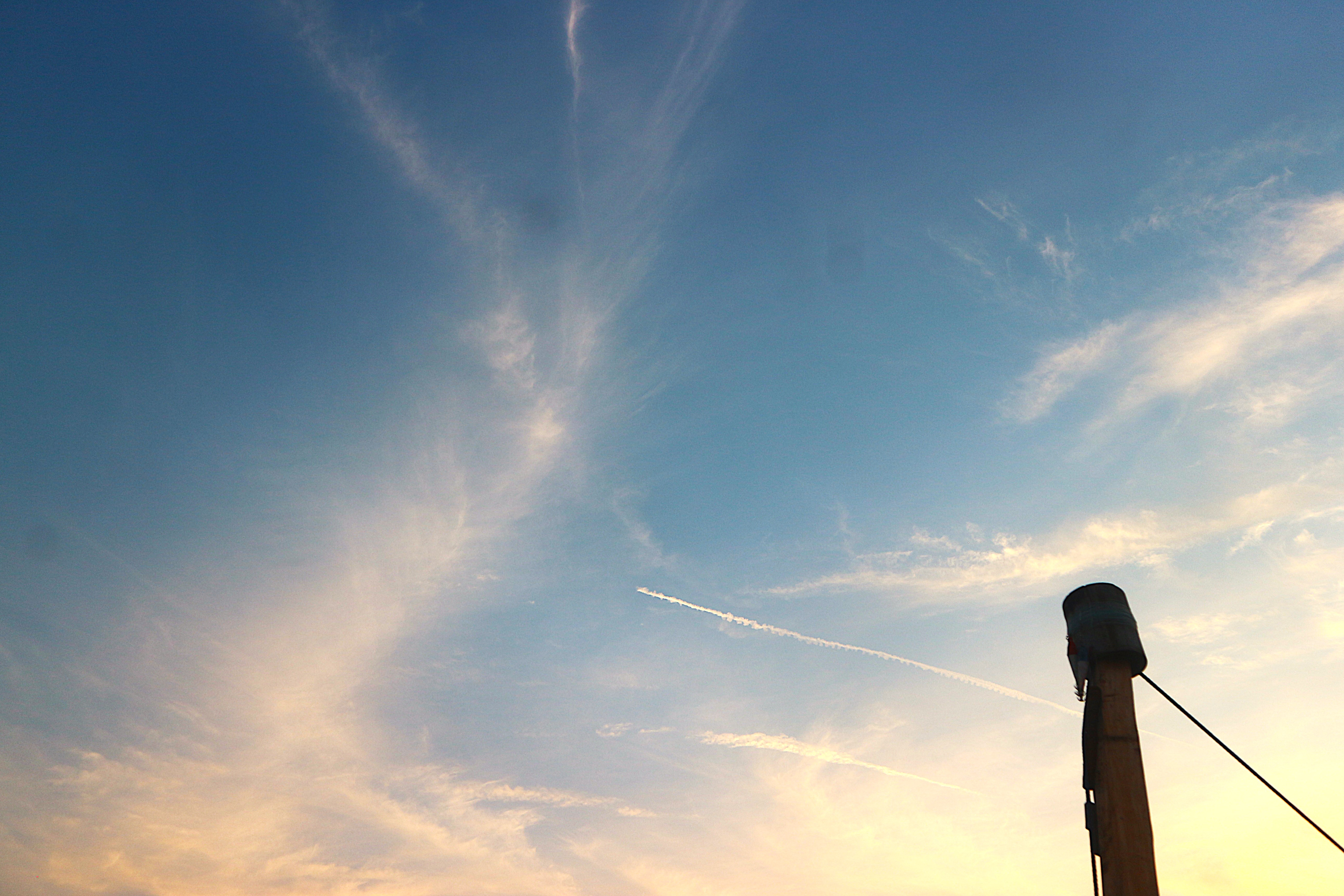
On a traditional fishing boat, a simple wooden pole rises above the deck.
The pole is usually used to hold coiled fishing lines and hooks, keeping them within easy reach when the fishermen go out to catch squid. There is nothing particularly remarkable about it. It is simply part of everyday life for fishermen in Nyamplungan Village.
But when you look up, something else begins to unfold.
A blue sky stretches endlessly above the waters of Nyamplungan Beach. The waves move gently below. Far above, an aircraft crosses the sky, leaving behind a long white trail.
For a moment, the line is clear.
Then, slowly, it begins to fade.
On the boat, a traveller sits alongside a traditional fisherman from Nyamplungan.
There is not much that needs to be done. No list of places to reach immediately. No schedule demanding attention. There is only the sea, the gentle movement of the boat, and the occasional invitation to look up.
Here, the life of a fisherman appears through simple things: a wooden pole, coils of fishing line and hooks used to catch squid, a boat carrying them out to sea, and time that moves according to the conditions of nature.
From this simple place to sit, the traveller begins to notice something that is so easily overlooked. The sky.
A white line moves across the blue.
The aircraft continues forward along a clear path, leaving a trail behind it. It is almost like the journey of a human being: moving towards a destination, following a chosen direction, and leaving something behind along the way.
But the trail does not last forever.
Little by little, the contrail fades until it becomes part of the vast sky once again.
Then there are the clouds.
They move without a clear line or fixed direction. Their forms are irregular, almost like brushstrokes from an expressionist painter. They do not attempt to represent the world objectively. They simply appear, free, unpredictable, and beautiful in their own way.
If the aircraft's line reminds us of order, direction, and deliberately made plans, the clouds suggest something different: freedom, emotion, uncertainty, and possibilities that cannot always be planned.
Perhaps life needs both.
We make plans. We choose directions. We create itineraries and decide where we want to go.
But not everything needs to be controlled.
Sometimes, we need to leave room for something to happen on its own, like clouds moving without an itinerary.
Beneath that sky, nature seems to offer a reflection of the human mind. Clouds scattered across the blue can resemble thoughts in turmoil, scattered dreams, or emotions overflowing within us.
Nature does not always need to be explained.
Sometimes, simply looking at it allows us to discover something about ourselves.
Travellers often move quickly because journeys are filled with destinations. One place must be reached, then another. Time is counted, schedules are arranged, and every pause can feel like something that needs to be filled.
Yet some experiences only appear when there is nothing to chase.
Sitting on a boat with a traditional fisherman from Nyamplungan, surrounded by a calm sea, and looking up at the sky creates a small pause. But it is precisely in such pauses that attention can return.
A traveller may begin to see something ordinary as something meaningful: an aircraft trail slowly disappearing, clouds changing shape, and the blue sky stretching beyond what the eye can measure.
The contrail reminds us that even what we leave behind will eventually fade.
The aircraft keeps moving forward, but its trail does not remain forever.
Perhaps a journey is like that too.
What matters is not only how quickly we arrive, but whether we are truly present while the journey is unfolding.
Perhaps one day, you will find yourself sitting on a traditional fishing boat in the waters of Nyamplungan, beside a fisherman.
You may not be heading towards anywhere new.
You are simply sitting, feeling the gentle movement of the waves, and looking up.
An aircraft passes overhead. A white line slowly appears, then begins to fade. Clouds move freely across the wide blue sky.
For a while, you do not need to think about where you are going next.
You can simply be there.
And perhaps, without noticing, a journey that once seemed to demand constant movement begins to reveal its meaning when you allow yourself to pause.
Sabato Kaliwuan creates access to moments of everyday life that might otherwise pass unnoticed.
Through encounters with traditional fishermen in Nyamplungan, Sabato Kaliwuan opens a space for travellers to see the sea not simply as a landscape, but as part of the lives of people who depend on it every day.
Sabato Kaliwuan acts as a mediator and a delightful companion, helping open the door to a closer encounter with local life without needing to fill every moment with activity.
Because sometimes, the most meaningful experiences emerge when there is nothing to do except sit, pay attention, and allow a place to speak in its own way.
Sabato Kaliwuan, A Delightful Companion for Your Journey.
More than a curated travel experience, Sabato Kaliwuan is an access point to authentic villages, meaningful encounters, and local stories that reveal the face of Central Java beyond its destinations. Through conversations with coffee farmers, local fishermen, artisans, and those building their communities, every journey becomes an opportunity to understand how villages continue to adapt, preserve their cultural heritage, and create new futures.
The sky above Nyamplungan seems to show us two things at once.
There is the aircraft trail, moving in a clear direction, much like people who make plans and set destinations. And there are the clouds, moving freely, without a form or direction we can fully predict.
Both exist within the same open space.
Perhaps travel is like that too. We need direction, but we also need room. We need plans, but we do not have to control everything that happens along the way.
In the end, lines fade. Shapes change. Traces disappear.
What remains is the open space to return to the present moment, to appreciate the calm sea, the blue sky, and the simple life unfolding before us.
Tag: adventure, centraljava, culture, ecotourism, familytravelers, jogja, karimunjawa, kotagede, local, nature, ngaduman, redefineluxury, sabatokaliwuanvibes, slowtravel, traditional, train