
When the Sea Takes a Pause
Here, slow travel is found in the pauses that follow the rhythm of a fishing community. When the sea recedes and the boats rest along the shore, life seems to take a breath as well. Nothing needs to be hurried. There is time to sit, observe, listen, and let nature be as it is, while fishermen, sea, wind, trees, and sand become part of the same living circle.
Today is much like yesterday, yet it is never quite the same. Only the weather makes the difference. And this is the kind of weather she likes.
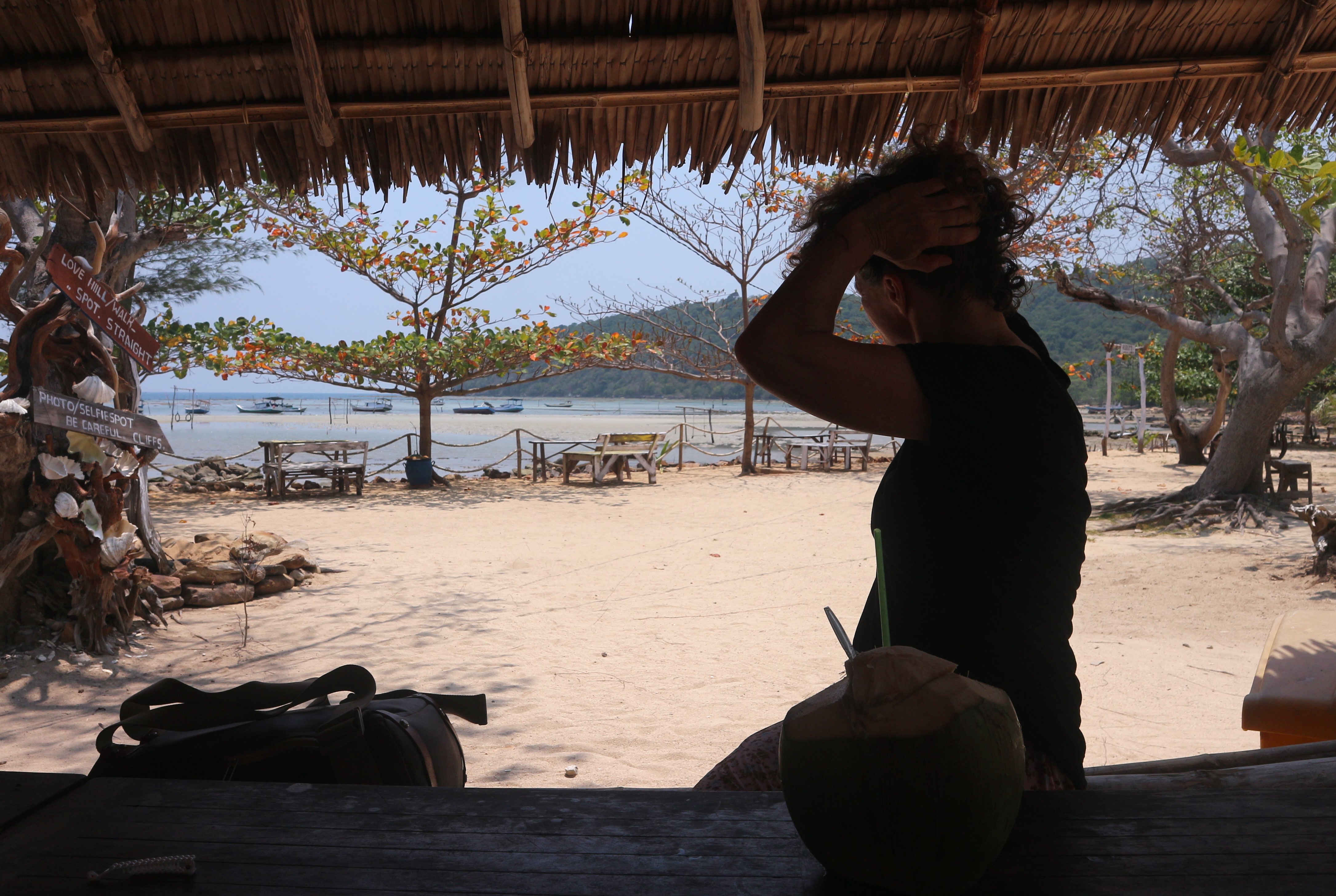
Basking in the sunlight, then resting in the cool shade beneath the simple roof of a fisherman’s house by the shore, made from sugarcane leaves. Eleven trees stand around the house. Some have begun to dry, their leaves slowly falling, yet they still offer their shade.
In front of her, seven traditional fishing boats are moored.
They seem to be enjoying the pause as well.
Some are no longer sitting perfectly upright. A few lean slightly to the right, almost as if they have settled into a comfortable position to rest.
The sea has receded.
And when the sea pauses, activity seems to pause with it.
In the distance, a hill with an uneven, asymmetrical line appears to stand guard over this quiet moment.
These are the kind of days a traveller might come to appreciate when there is nothing to chase. Not stopping because there is nothing to do, but stopping simply to enjoy a moment that does not need to be filled.
Sitting quietly.
Watching.
Feeling the slow changes of nature unfolding in front of her.
In her hand is a fresh young coconut. Around her, the leaves of seven golden candlestick (Terminalia catappa) display a changing palette of colours. One tree is still dressed in colour, while the tree beside it has almost completely shed its leaves.
White sand.
Blue sea.
Green hills.
The colours meet without anyone having arranged them.
And somewhere among them, she finds a shade deep enough to make him still.
In a place like this, the local fishing community does not need to explain how nature should be experienced. They simply live within a rhythm that has long been part of their everyday lives.
The sea recedes, and the boats wait.
The wind moves.
Leaves fall.
Small creatures move across the shore.
And people remain in the middle of it all.
We have all heard the sound of wind, the sound of waves, even the movement of creatures along the beach. Yet we rarely stop to ask why the waves murmur, why the wind hisses, or why the movements of small beach creatures rustle across the sand.
Following the steps of the local fishing community opens a possibility of hearing stories about things we may never have heard or known before.
Here, there is no need to sing.
No need to hum.
No need to paint.
Not even a need to take a photograph and share it.
All that is needed is silence.
Perhaps this is what the place quietly teaches. We do not always come to nature to do something to it.
Sometimes, we simply need to sit within it.
To watch.
To feel.
To taste food from the earth, served warm and touched by the sunlight, accompanied by the freshness of a young coconut.
This place gently moves us away from the desire to dominate the earth and allows us to feel a sense of harmony, as part of a whole ecosystem. Far, too, from the desire to possess anything beneath our feet.
We often claim that the earth is lifeless matter. Yet here, perhaps, it feels different.
Every grain of sand.
The sea.
The trees.
The wind.
And the creatures living around us. All of them appear as part of the same circle.
The local fishing community, white sand, sea, wind, leaves, young coconuts, hills, and beach creatures become companions in a moment of pause.
And for a while, there is no need to ask how much any of it is worth.
Perhaps one day, you will sit beneath the simple roof of that fisherman’s house while the sea is receding.
Perhaps seven boats will be moored in front of you, some leaning slightly as though they, too, have found a moment to rest.
You may have nothing more than a fresh drink, something warm to eat, and enough time to do nothing at all.
And slowly, you begin to listen.
The wind.
The waves.
The small movements of life across the sand.
Perhaps then you will realise that silence can also be a way of encountering a place.
Sabato Kaliwuan does not bring you to the beach simply to see the sea.
Sabato Kaliwuan opens the door to the everyday life of the local fishing community, creating access to stories and ways of seeing that might otherwise remain unheard.
Through these encounters, the beach becomes more than a place to visit. It becomes a space for understanding how people, the sea, the wind, trees, and the life around them exist in relationship with one another.
Sabato Kaliwuan, A Delightful Companion for Your Journey.
More than a curated travel experience, Sabato Kaliwuan is an access point to authentic villages, meaningful encounters, and local stories that reveal the face of Central Java beyond its destinations. Through conversations with coffee farmers, local fishermen, artisans, and those building their communities, every journey becomes an opportunity to understand how villages continue to adapt, preserve their cultural heritage, and create new futures.
Perhaps we come to places too often wanting to do something.
To see. To photograph. To share. To possess.
Yet there are places that quietly ask us to do the opposite.
To be silent. To sit. To watch. To feel.
And to allow ourselves to become a small part of a circle of life far greater than ourselves.
Perhaps a pause is not emptiness.
Perhaps a pause is the moment when we finally have enough time to realise that we were never truly separate from nature.
Tag: adventure, centraljava, coffe, culture, ecotourism, familytravelers, jogja, karimunjawa, kotagede, local, nature, ngaduman, redefineluxury, sabatokaliwuanvibes, slowtravel, traditional, train