
When the Journey Finally Becomes a Reflection
In Blitar, slow travel does not end when the bicycle stops or when the journey returns to the Sabato Kaliwuan host’s home. It continues through what has been seen, heard, felt, and encountered along the way. From Pasar Pon and Pasar Dimoro, through rice fields and quiet village roads, to a local batik workshop and the southern coast, every encounter leaves something worth taking time to remember, reflect upon, and write down.
There is a kind of magic you cannot find behind a car window.
Something that can only be felt when you ride a bicycle slowly, allowing the countryside breeze to brush across your face. That morning, accompanied by Sabato Kaliwuan, the traveller followed an alternative village road towards two traditional markets: Pasar Pon and Pasar Dimoro.
These two markets offer more than everyday necessities. The lively livestock market creates a symphony of its own. Along the way, Sabato Kaliwuan led the traveller into the middle of the local crowd, where there was time to stop and take it all in.
Slowly, the traveller began to settle into the atmosphere. Fragments of conversation passed between sellers and buyers. The market revealed itself not simply as a place of trade, but as a living space for people to meet, talk, and maintain their ties.
After taking in the energy of the market, the journey continued. Sabato Kaliwuan accompanied the traveller back onto the bicycle, following the quieter village roads.
Along these roads, time seemed to move more slowly.
From the bicycle, the traveller watched scenes unfold one after another, like frames from an old film: farmers working patiently in the fields, a thin cloud of dust rising from a woman sweeping the front of her home, and the familiar scent of rice drying in an open yard.
Simple things, yet somehow unforgettable.
The slow ride eventually led to a modest workshop belonging to a local batik artisan. Here, white cloth slowly became batik artwork.
With Sabato Kaliwuan, the traveller had the chance to sit down and talk with the artisan. It was not simply a conversation. The traveller was invited to try.
“Hold the canting like you would hold a pen, but move it with feeling,” the artisan said.
The traveller followed the movement, drawing the hot wax along the pattern until it was complete. The experience continued on a smaller piece of cloth with a different motif.
With slow, deliberate movements and full concentration, the traveller guided the canting across the small piece of fabric until the final line was drawn.
Then, with a sense of pride, the traveller placed a name beneath the work.
A small sign that, on that day, the traveller was no longer simply a tourist passing through, but had become a small part of the village's story.
After exploring Blitar, its town and surrounding villages, the journey continued south the following day, towards Gondomayit Beach and the fish market.
There, the traveller met fishermen who also sold fresh fish. They talked. The traveller listened to their stories. Before leaving, they shared a local meal, with fresh squid and sea fish as part of the meal.
There is something different about a place when it is not simply observed, but entered through the lives of the people who live there.
The southern coast was no longer simply a stretch of sea along the journey. It was experienced through the movement of waves against the traveller’s feet and hands, through the fish market, through conversations with fishermen and sellers, and through food shared.
The physical journey kept moving.
But not everything encountered along the way had to move on with it.
The journey back from South Blitar had ended.
The sea was no longer in front of the traveller, yet something from the coast remained. The evening breeze still lingered in the senses. So did the aroma of grilled squid and fish, the sound of the waves, the lingering salt in the air, and the memory of a day spent at Gondomayit Beach.
A journey can leave behind more than photographs.
It can leave behind faces, voices, aromas, textures, and small moments that remain in the memory. Conversations with people at the two traditional markets, with the local batik artisan, with fishermen, and the fresh fish shared over a meal – all of them become something to reflect upon.
Slow travel does not simply end when the journey is over.
Sometimes, what has been experienced needs time to settle.
Perhaps after a day exploring South Blitar, the traveller will return to the Sabato Kaliwuan host’s home carrying more than the tiredness of the journey.
Perhaps the evening breeze will still bring back memories of the southern coast. Perhaps the traveller will think of the fishermen met at the market, the meal shared, the aroma of fish and squid grilling over coconut-shell charcoal, and the movement of the waves at Gondomayit.
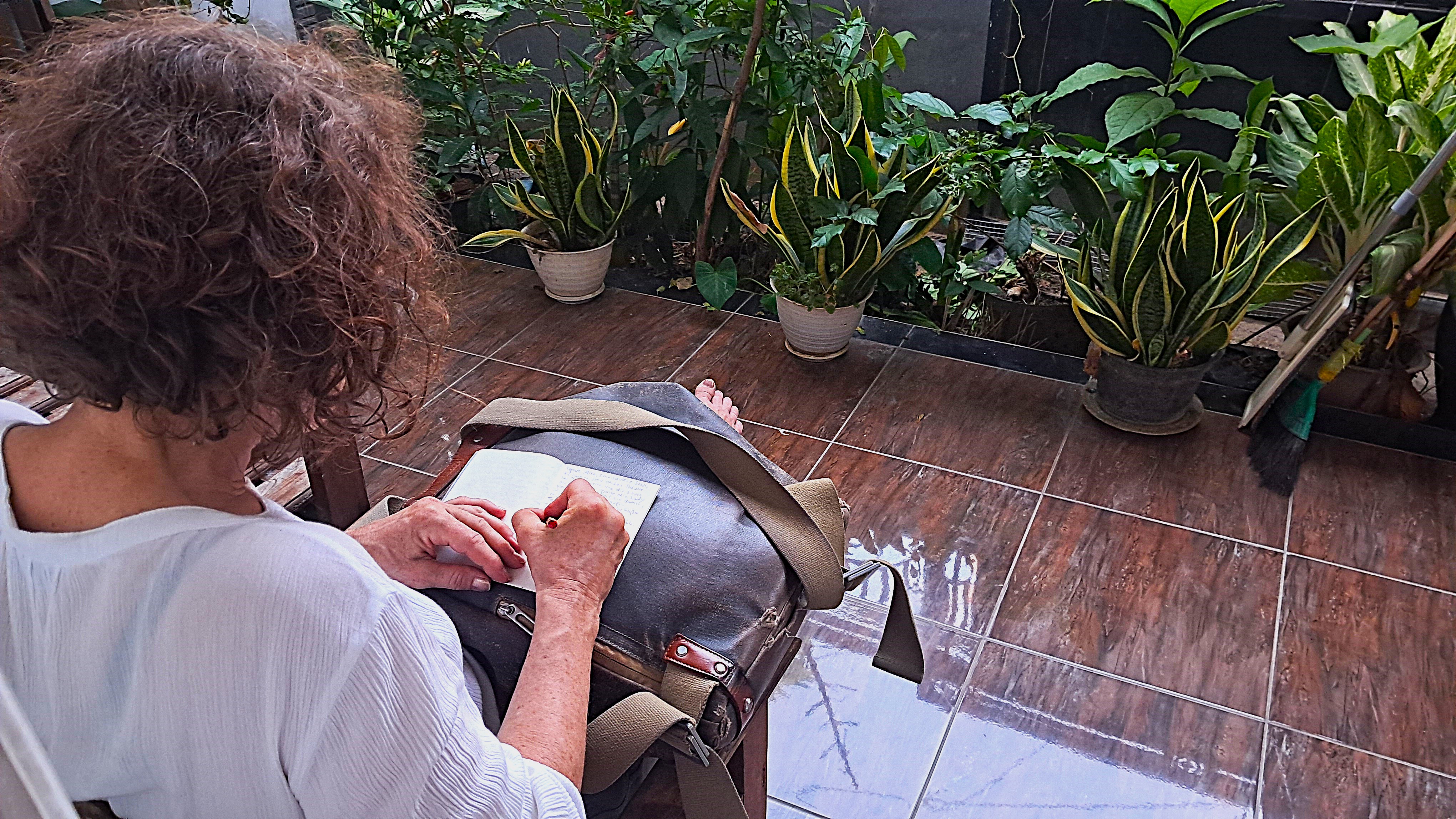
Then perhaps the traveller will sit on a simple wooden chair on the terrace, place the bag on their lap, open a journal, and let the pen follow whatever remains in the memory.
There is no need to explain everything.
Just write.
One memory at a time.
Sabato Kaliwuan creates access to encounters that continue beyond the places you visit.
Sabato Kaliwuan connects travellers with local life in Blitar, from the everyday rhythms of Pasar Pon and Pasar Dimoro, the quiet village roads, and encounters with local artisans, to fishermen and the people whose lives shape the places they call home.
Sabato Kaliwuan is not there to fill the journey with destinations. It creates space for travellers to slow down, meet people, listen to their stories, and allow each encounter to become part of the journey.
As a mediator, storyteller, and delightful companion, Sabato Kaliwuan opens the door not only to experiencing a place, but also to reflecting on what that experience leaves behind.
Sabato Kaliwuan, A Delightful Companion for Your Journey.
More than a curated travel experience, Sabato Kaliwuan is your access to authentic villages, meaningful encounters, and local stories that reveal East Java beyond sightseeing. Through conversations with the people who shape village life, every journey becomes an opportunity to understand how villages are adapting, preserving their heritage, and creating new futures.
On a simple wooden chair on the terrace of the Sabato Kaliwuan host’s home, time seems to move more slowly.
In front of the traveller, a small patch of earth becomes a simple yet living green oasis. Fragrant herbs grow among the flowers, forming a small garden that feels naturally woven into the everyday life of the home.
From the north, a gentle breeze moves across the wide expanse of green rice fields. It passes over the chest-high wall separating the house from the open landscape, bringing a freshness that feels different after the heat of the journey and the strong aromas of the fish market at Gondomayit Beach.
The body has returned from the journey.
But the mind has not completely arrived.
The sea is still there in the memory. The movement of the waves. The stories of the fishermen. The aroma of fresh fish and squid grilling over coconut-shell charcoal. The silver flash of fish scales. And the quiet contrast of Gondomayit’s white sand meeting the Indian Ocean.
Then the pen begins to move.
Journaling here is not simply a way to record where the traveller has been. It becomes a way to process what, and who, the traveller has encountered.
Reflection does not always mean daydreaming. Sometimes it means giving yourself enough space to understand what a journey has left behind.
The eyes rest on the green leaves. The nose catches the faint scent of herbs. The skin feels the coolness of the evening breeze.
Slowly, the physical experience of the day begins to become something else.
The energy of the Indian Ocean, the movement of the waves, the liveliness of the market, and the encounters with fishermen and the local batik artisan are no longer only physical experiences. They become memories. They become thoughts.
And through the simple act of writing them down, the journey begins to find another kind of meaning.
Silence does not mean the absence of sound.
Silence is a state in which the mind and spirit finally have enough room to become still.
Although the Sabato Kaliwuan host’s home is still within the city, the terrace creates a little distance from its bustle.
This is one portrait of Blitar.
The journey outside slowly becomes a journey inward.