
When Blitar Falls Quiet, Life Begins to Speak
At the Sabato Kaliwuan host home, slow travel is not about following a list of activities. It is felt in the rhythm of a village morning: wild birds singing, children leaving for school, motorcycles passing by, and then, gradually, silence returning. In these pauses, travellers begin to know Blitar, not through a list of places, but through the everyday rhythm of local life.
The first day at the Sabato Kaliwuan host home is a day of adjustment. Not an adjustment to crowds, but to quietness.
Although still within the city of Blitar, the surroundings of the house feel remarkably peaceful. Morning begins with several kinds of wild birds singing from the mango tree where they have made their nests. From inside nearby homes come the voices of children getting ready for school. Soon, the sound of motorcycles begins to pass through the neighbourhood, taking children to school while parents head out for their daily activities.
Then, little by little, the sounds disappear.
Breakfast is served with traditional snacks, accompanied by Sumberurip coffee and conversation around the dining table. In the middle of their conversation, the couple begins to notice just how quiet the neighbourhood around the Sabato Kaliwuan host home has become.
“Why has everything become so quiet now? Where have the children and all the people gone?”
Sabato Kaliwuan answers simply "This is what our neighbourhood is like in the morning, in the afternoon, in the evening, and even as night approaches,".
They smile.
And once again, they remember something Sabato Kaliwuan had told them before:
“Blitar is a retirement town.”
From the Sabato Kaliwuan host home, their journey begins to find another way of knowing Blitar.
Not by rushing to find what there is to see, but by paying attention to what is already happening around them.
Meet Someone
After breakfast, Sabato Kaliwuan accompanies them on a walk through the narrow lanes of the neighbourhood.
The lanes are decorated with red-and-white flags and festive banners in preparation for Indonesia's Independence Day on 17 August. They stop to photograph the lanes and their small details, then continue walking without needing to hurry towards the next destination.
At one of the houses, they meet a traditional kite maker.
They stop, talk, and watch how the kites are made. Bamboo forms the frame, which is then covered with plastic. Locally, this is familiar as Sowangan.
Sowangan refers to a large kite fitted with a ribbon, or sendaren, a thin strip of bamboo that produces a buzzing sound when caught by the wind.
When several kites are flying at once, the sound can become a deep roar, almost like the sound of a helicopter.
The kites do not simply remain still in the sky. They can also “Joget”, moving from left to right, like a neck gently turning from one side to the other.
From the kite maker's house, their walk continues to the home of Ibu Sam. It is not far away, still within the same neighbourhood.
Ibu Sam makes traditional foods and snacks from cassava, usually finished with freshly grated coconut. Sawut, cenil, gathot, thiwul, ketan, and other traditional snacks are prepared in her home.
One of them has already been part of their breakfast.
At Ibu Sam's house, they do more than taste the food. They sit together, talk, and watch how it is made, from the semi-finished ingredients until everything is ready to be served.
There is no need to travel far.
The kite maker's house and Ibu Sam's home are only about 100 to 200 metres apart. The Sabato Kaliwuan host home is also nearby. As midday approaches, they return to the house.
In the afternoon, they walk again.
This time, they follow a village road that also serves as an alternative route for passing motorists. Rice fields still stretch along both sides. During the dry season, farmers plant corn.
They walk until they stop for a while beside the fields, near the railway tracks.
There, they notice something even more ordinary: the air.
“Blitar is not as hot as the cities we visited before. You can really feel the breeze here. We don't feel the heat at the Sabato Kaliwuan host home either.”
Yes.
The Sabato Kaliwuan host home is surrounded by fields.
They continue walking. They follow the main road, a provincial road, for several dozen metres before turning back into a shortcut through neighbourhoods and residential areas.
People they pass greet them. They return the greetings.
And once again, they notice the quietness of the streets as they move from one neighbourhood to another.
Eventually, the smaller road meets the main road again.
A few metres farther, they reach the railway tracks once more.
This time, a train is approaching.
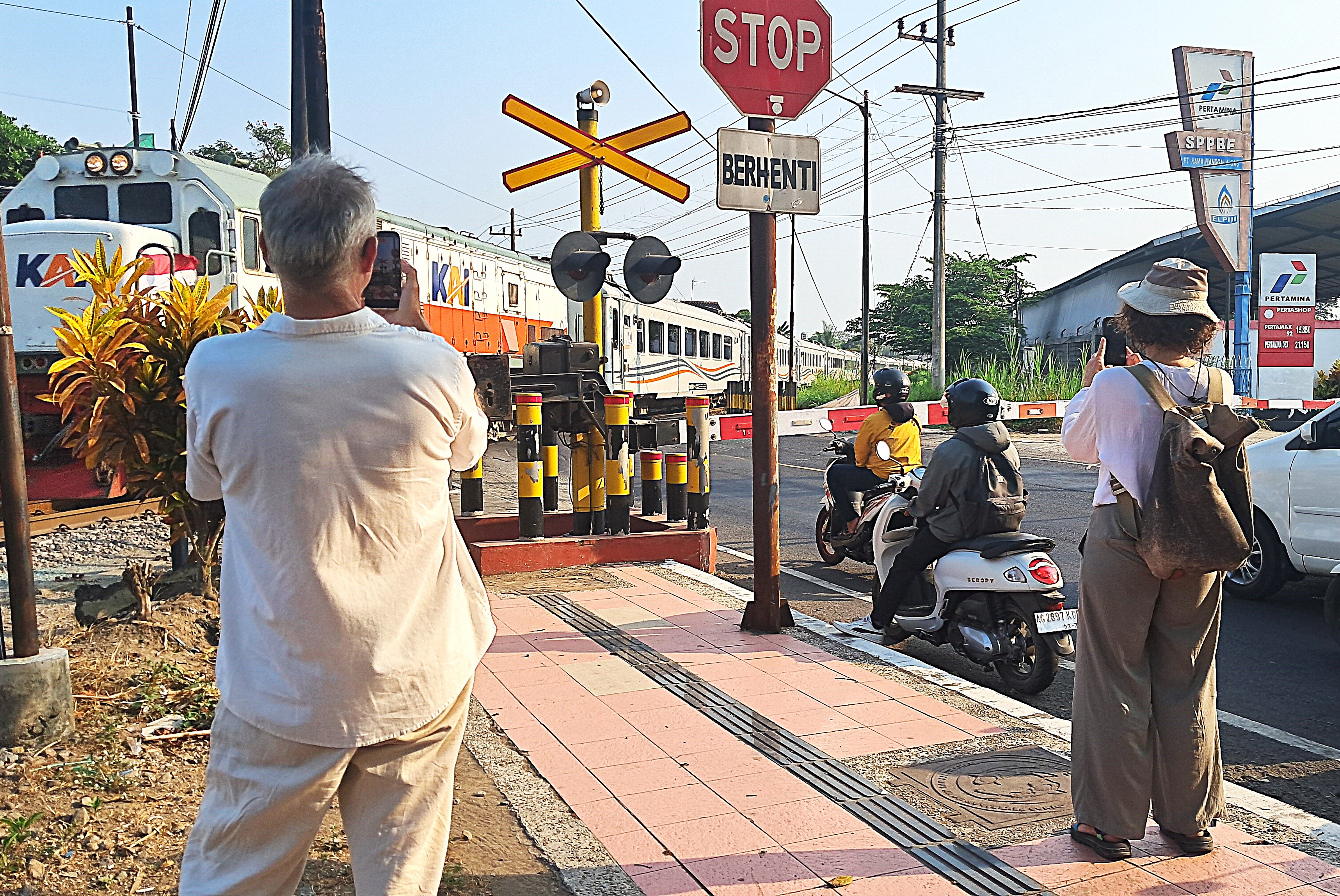
They stop in front of the railway crossing. The familiar sound of the loudspeaker mounted on the pole beside the tracks rings out, followed by the lowering of the barrier.
The couple waits with their phones in hand, ready to capture the passing train.
The train begins to appear. For a moment, their journey seems to stop.
There is something they gradually discover in Blitar: quietness does not mean that there is no life.
In fact, within the quiet, everyday life becomes easier to notice.
The birds singing in the morning. Children leaving for school. Residents sitting and talking. A kite maker still working with his hands. Ibu Sam preparing traditional snacks from cassava. Fields surrounding the house. The breeze felt beside the rice fields. And a train occasionally cutting through the silence.
None of it needs to be scheduled.
As the train begins to pass before them, it feels as though a message is being sent to the travellers inside:
“Blitar is the right city to choose when your soul needs a pause and a little rest.”
A pause from packed itineraries. A pause from the weariness of mass destinations.
Before them, the signs are simple yet strangely expressive: a yellow cross marked on the railway barrier, two red lights flashing alternately, and a red signboard bearing the word:
“STOP.”
As if a journey does not always ask us to keep moving. Sometimes, it asks us to stop.
And look.
Perhaps one morning, you will sit at the dining table with a cup of Sumberurip coffee, while birds singing from the mango tree become the first sound you hear.
Perhaps, after breakfast, you will walk without needing to chase too many places, greeting residents, stopping at the home of a traditional kite maker, watching Ibu Sam prepare cassava-based snacks, and pausing beside the fields when the breeze begins to rise.
Perhaps you will reach a railway crossing and wait for a train to pass, your phone in your hand.
And when the train disappears, perhaps what remains will not be a list of places you have visited, but the feeling that you have just encountered a small part of everyday life in Blitar.
Sabato Kaliwuan does not take travellers simply from one place to another.
Sabato Kaliwuan creates access for travellers to enter the everyday life of the local community, to walk through village lanes, meet a traditional kite maker, encounter Ibu Sam, taste food prepared by local people, feel the breeze across the fields, and pause when a train passes by.
Sabato Kaliwuan is present as an access, mediator, storyteller, and delightful companion.
Not to decide what travellers must see, but to open a door through which they can see, hear, and feel more closely.
Sabato Kaliwuan, A Delightful Companion for Your Journey.
More than a curated travel experience, Sabato Kaliwuan is your access to authentic villages, meaningful encounters, and local stories that reveal East Java beyond sightseeing. Through conversations with the people who shape village life, every journey becomes an opportunity to understand how villages are adapting, preserving their heritage, and creating new futures.
Perhaps what makes a journey feel slow is not the number of places we visit.
It is the space we give ourselves to remain a little longer with what is happening.
In Blitar, a morning may begin with birds and children leaving for school, and then slowly return to silence. A narrow lane may lead us to a kite maker. A house may introduce us to Ibu Sam. A road between fields may make us stop because of the breeze. And a railway crossing may remind us that sometimes, we need to stop for a while.
That is where the journey begins to find its meaning. Not in how much we have seen.
But in how deeply we have allowed something simple to be felt.