

Traces of a Traveler From Ijen's Fire to Bromo's Sunrise
From the Island of Dreams to the Eastern Gate of Java
The journey begins in Bali, the island that never truly sleeps.
After days drenched in sunlight, music, and the rhythm of the sea, foreign travelers start to drift westward, toward another island whispered to hold a different kind of beauty.
By late afternoon, the ferry slowly departs from Gilimanuk Harbor.
The Bali Strait ripples quietly, while the setting sun casts golden reflections across the surface of the water. From the deck, a faint line of land begins to rise on the horizon. Banyuwangi, the eastern gate of Java, wrapped in mist and the silhouettes of distant mountains.
As the ferry docks at Ketapang Harbor, the salty scent of the sea mingles with the warmth of the land breeze. Here, the true Javanese adventure begins a long, winding journey that will lead them from volcanic peaks to seas of sand, from the bustle of world-famous attractions to the stillness of places few have ever reached.
The Common Path – Mapping the Eastern Journey
For most travelers, this is the classic route to the heart of Java: Banyuwangi – Ijen – Malang – Bromo – Yogyakarta.
A road stitched together by world-class landscapes and familiar names on the global tourism map.
The beginning always carries a pure kind of excitement, that unspoken thrill of stepping onto new ground, of sensing that something unexpected awaits. Leaving Ketapang behind, the road winds through silent teak forests. Along the way, long-tailed macaques (Macaca fascicularis) perch on tree branches, watching curiously as cars pass by.
The asphalt twists through valleys and gentle slopes, passing signboards pointing toward other wonders: Ijen, Baluran, Alas Purwo. The scenery feels cinematic, a journey bathed in light, framed by dust and motion. Drones hum above like a chorus of bees; cameras rise to capture every fleeting ray of sunlight before it fades.
There’s a fire that keeps the spirit alive, but behind the excitement, fatigue begins to hum quietly.
Schedules are tight, transitions are fast, and sometimes travelers forget that to wander is not merely to move, but to pause to listen to the wind, to the language, and to the stories of those who live along the way.
Kawah Ijen – A World-Famous Wonder
The Geography of Ijen
Kawah Ijen lies within the vast Ijen volcanic complex, a 20-kilometer-wide caldera straddling the border of Banyuwangi and Bondowoso, East Java. The summit of Mount Ijen rises to 2,386 meters above sea level, surrounded by a necklace of peaks: Mount Merapi (2,799 m) to the north, not to be confused with the Merapi of Central Java — Mount Raung (3,332 m) to the southwest, Mount Suket (2,950 m) to the northwest, and Mount Rante (2,664 m) with Mount Pendil (2,343 m) standing guard to the west and south.
At its heart lies a surreal turquoise lake, about 200 meters deep and 0.45 square kilometers wide — the largest acidic crater lake on Earth, with a pH of barely 0.5. The air carries a faint tang of sulfur, and wisps of smoke drift lazily across the water’s surface, creating an atmosphere both haunting and breathtaking.
The Trek to the Crater
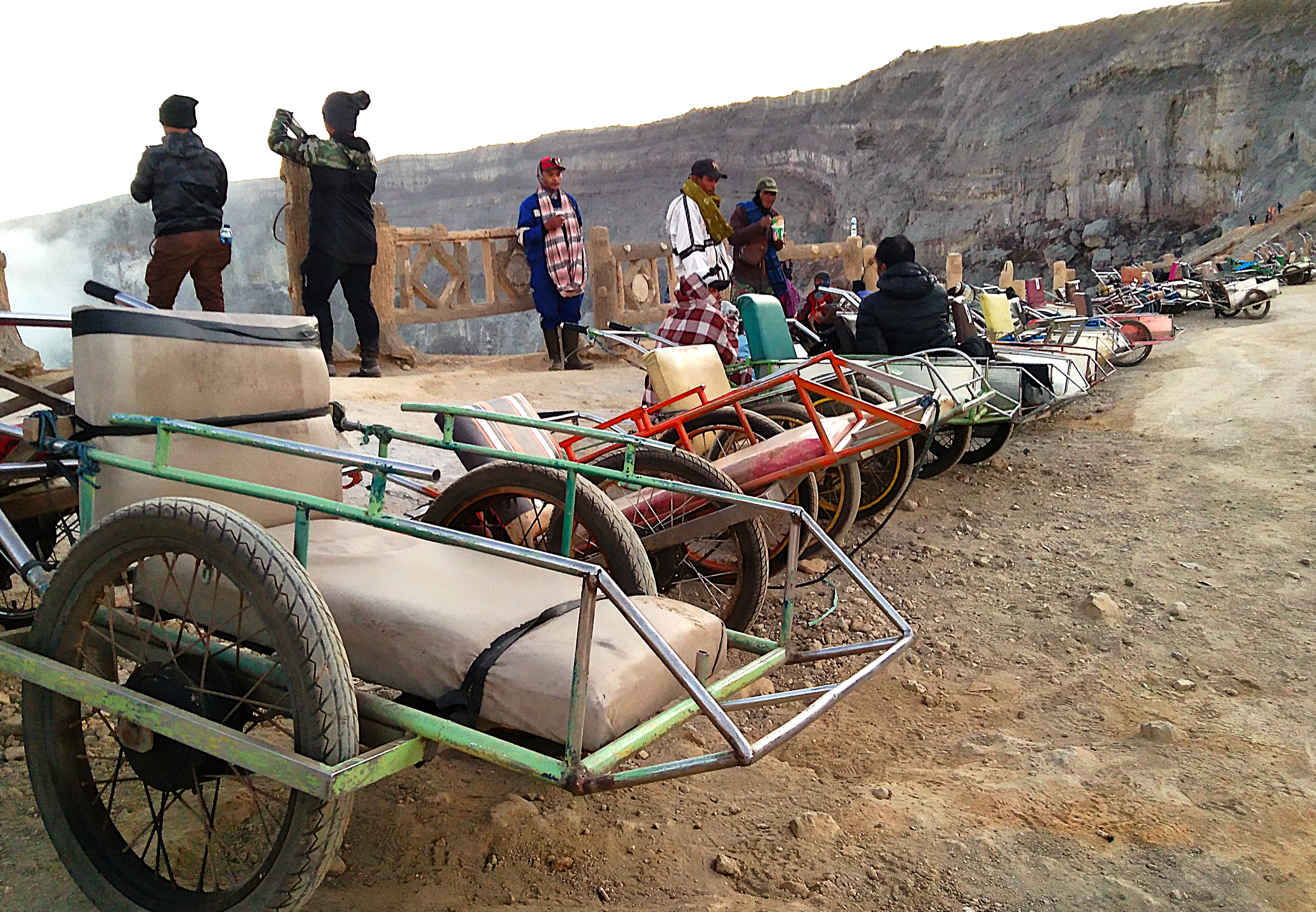
The main trailhead begins at Paltuding Post (altitude 1,850 m), roughly a 1.5–2-hour drive from Banyuwangi city. From there, it’s a 3-kilometer hike to the crater rim, ascending about 536 meters in total, a journey that usually takes between 1.5 and 2 hours, depending on fitness and pace.
The first kilometer is a gentle introduction — flat to slightly uphill, with a slope of 10–15°. The path is compact dirt mixed with fine sand, shaded by pine and acacia trees whose scent mingles with the morning air.
The second kilometer grows steeper, reaching inclines of 25–35°. The forest opens up, the soil turns to volcanic dust, and the only sounds left are footsteps, breathing, and the distant hiss of the wind.
Tag: blitar, blitarstopover, bromo, culture, ecotourism, familytravelers, indonesiaspicingtheworlds, local, nature, sabatokaliwuanvibes, slowtravel, soekarnolegacy, traditional, train