
The Silver Remembers: A Ring Shaped by the Hands of Kotagede
In Kotagede, Yogyakarta slowing down means allowing the hands of a silversmith to set the pace. Away from the bustle of the market and the displays of finished jewellery, time is measured through the patient rhythm of a hammer, the careful shaping of silver, and the concentration passed down through generations of artisans. Sitting beside a craftsman like Pak Bandiono offers a different way to understand silver, not simply as a precious material, but as a living tradition sustained by human skill and dedication.
The damp bustle of Pasar Legi still lingers in the air as you leave the market behind. Gradually, its overlapping voices give way to the quieter rhythm of narrow alleyways, where tall walls enclose the grounds of Museum Kotagede and the imposing Rumah Kalang, once belonging to the merchant B.H. Noerijah, stands as a reminder of the area's prosperous past.
Here, the pace of the surroundings begins to change. There is no need to hurry towards the next landmark. Instead, the journey leads you towards a silversmith's home, where the story of Kotagede's silver craftsmanship continues in a modest workshop.
Inside, silver takes on a different meaning. Away from the gleam of finished jewellery displayed behind shop windows, the material is worked patiently by hand. Raw silver is melted, drawn into finer forms, and shaped through movements that demand precision and concentration. Each tap of the hammer seems to belong to a rhythm that has little in common with the hurried pace of modern life.
To pause here is not simply to sit still. It is to give your attention to the making itself, to watch how an ordinary piece of metal gradually becomes something personal, shaped by the patience of the person working it.
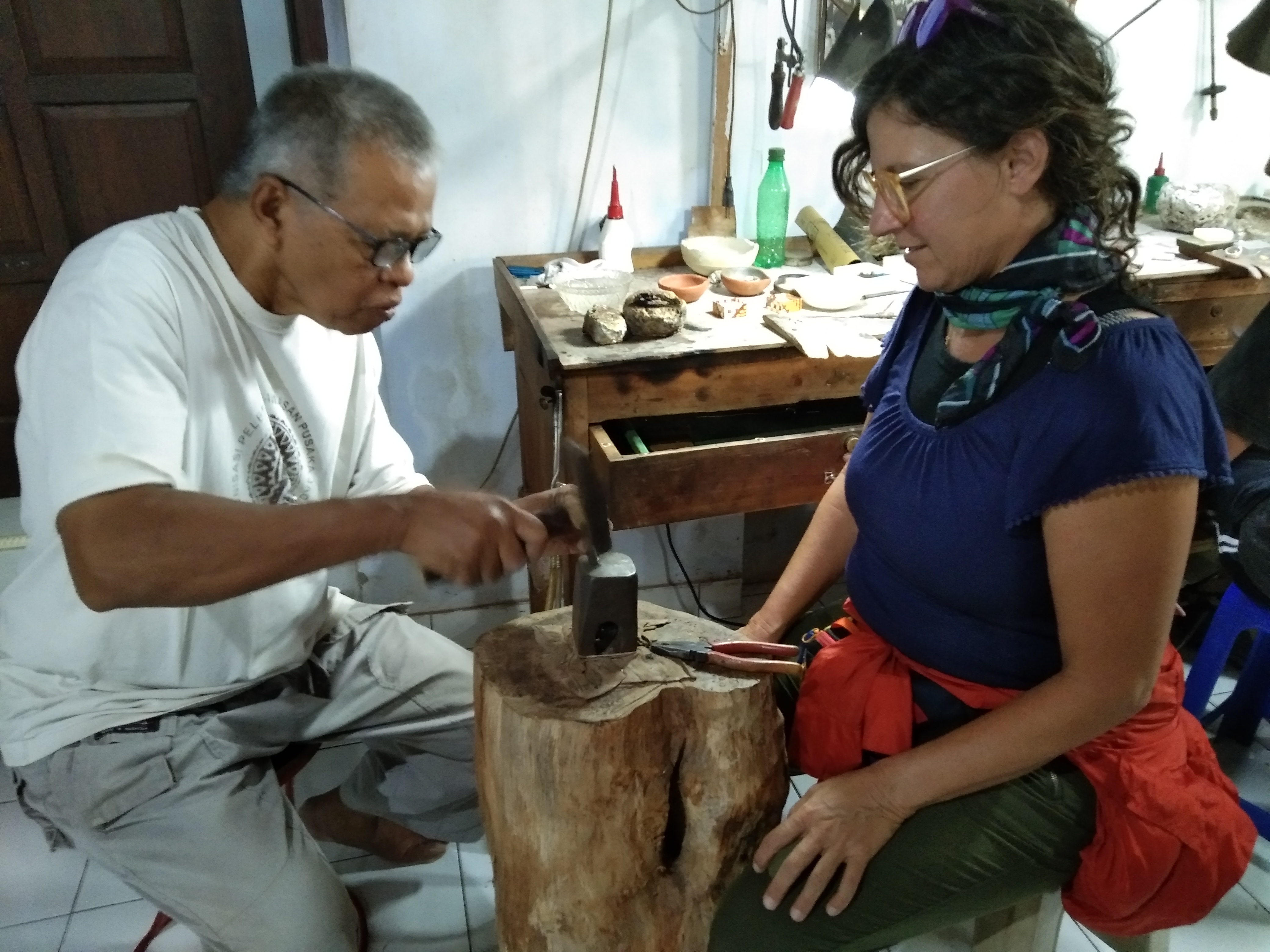
At a modest wooden workbench, Pak Bandiono sits with his shoulders slightly bent forward, his attention fixed on the delicate work before him. His reading glasses rest low on his nose as his fingers carefully bring together tiny pieces of silver wire. Every so often, he looks up when he hears footsteps approaching, briefly acknowledging the presence of a visitor before returning to his work.
There is a quiet attentiveness in the way he works. His movements are deliberate, guided by the kind of concentration that leaves little room for haste. The workbench is not particularly high, and his posture reflects the care required to handle such fine materials.
Yet Pak Bandiono does not keep his craft at a distance. He welcomes you into his working space and invites you to try making a silver ring of your own, guiding you through the process as you begin to understand how much patience even a small piece of jewellery requires.
Under his guidance, the experience becomes more than watching an artisan at work. Your hands begin to engage with the material, and the distance between observer and maker gradually narrows. The silver no longer appears as something finished and effortless. It becomes something you have watched take shape, and, in a small way, helped bring into being.
Kotagede's silver tradition carries memories of a time when the area was closely associated with the history of the Islamic Mataram Kingdom. Its craftsmanship remains one of the ways that the area's cultural identity can be encountered through everyday life.
In Pak Bandiono's workshop, that heritage is not presented as a distant chapter of history. It continues through the tools he uses, the movements he repeats, and the attention he gives to each piece of silver. The work unfolds through practical knowledge, developed through experience and sustained by the hands of artisans across generations.
As you watch him shape and polish a ring, you begin to notice how much of the craft depends on things that cannot be hurried. A piece of silver must be handled with care; its shape emerges through a succession of small, considered movements. The final result depends not only on the material itself, but also on the skill and judgement of the person working with it.
Pak Bandiono continues to rely on manual tools even as factory production and three-dimensional printing offer other ways of making objects. His choice keeps the human hand at the centre of the process, allowing the work to retain the character of a craft practised through direct contact with the material.
There is something quietly revealing about this persistence. The workshop does not need to announce its connection to the past. It expresses that connection through the work taking place each day.
And when you are given the chance to make a ring yourself, even a brief participation offers a glimpse into the patience behind the finished object. What once appeared to be a simple piece of silver begins to carry the memory of a process, a place, and the person who guided your hands.
The value of Kotagede's silver craftsmanship cannot be measured by the brilliance of its finished jewellery alone. Much of its meaning lies in the quiet process through which raw material becomes an object of lasting significance.
Pak Bandiono's workshop offers a glimpse of how cultural heritage survives through ordinary acts of dedication. It is not preserved only in museums or historic buildings, but also in the decisions artisans make every day: to continue using familiar tools, to maintain their skills, and to give their attention to work that demands patience.
In a world increasingly shaped by speed and machine production, this kind of craftsmanship reminds us that efficiency is not the only measure of value. The human hand brings judgement, sensitivity, and individual attention to a process that cannot be fully understood by looking at the finished product alone.
For travellers, the encounter changes the way a silver ring is perceived. Its worth is no longer confined to its material or appearance. It also lies in the time spent observing its creation, the guidance received from an experienced artisan, and the connection formed with someone whose work sustains a living tradition.
Sometimes, the most meaningful way to understand a place is not to collect another object from it, but to discover the human effort and knowledge that have shaped it.
Perhaps one afternoon, you will leave the bustle of Pasar Legi behind and follow a narrow alley through Kotagede. Beyond the tall walls and the historic houses, you may arrive at Pak Bandiono's workshop, where the sound of a small hammer offers a quieter rhythm to the day.
You might sit beside his wooden workbench, watch his fingers work the silver, and accept his invitation to make a ring of your own. Your first movements may feel unfamiliar, and the process may take more patience than you expected. Yet that is part of the experience: learning to give your attention to something that cannot be rushed.
Later, as you look at the ring resting on your finger, you may remember more than its polished surface. You may recall the warmth of the workshop, the concentration in Pak Bandiono's movements, and the moment he paused to guide you through the work.
The ring will be small enough to carry anywhere. But the memory attached to it may bring you back to an afternoon when you discovered that the meaning of an object can lie as much in the hands that shaped it as in the material itself.
Sabato Kaliwuan opens the door to Kotagede's living traditions by connecting travellers with the people who continue to practise and preserve them.
Through an encounter with a silversmith like Pak Bandiono, Sabato Kaliwuan creates access to a side of the neighbourhood that cannot be understood through historic landmarks or finished products alone. It allows travellers to come closer to the everyday lives of local artisans, where knowledge, patience, and cultural memory remain part of the work itself.
Sabato Kaliwuan create space for these encounters to unfold naturally. Rather than making the experience a sequence of activities to complete, it connects travellers with people whose stories and skills offer a deeper understanding of the place they inhabit.
As a mediator, storyteller, and delightful companion, Sabato Kaliwuan encourages a more personal relationship between traveller and destination, one shaped by listening, observing, and, when the opportunity arises, taking part.
Sabato Kaliwuan, A Delightful Companion for Your Journey.
More than a curated travel experience, Sabato Kaliwuan is an access point to authentic villages, meaningful encounters, and local stories that reveal the face of Central Java beyond its destinations. Through conversations with coffee farmers, local fishermen, artisans, and those building their communities, every journey becomes an opportunity to understand how villages continue to adapt, preserve their cultural heritage, and create new futures.
When you eventually leave Kotagede, the silver ring on your finger may catch the light as you move. Its surface will reflect the world around you, but its meaning may reach beyond that fleeting glimmer.
You may remember Pak Bandiono leaning over his workbench, the careful movements of his fingers, and the patience with which he guided you through the making of something small. What remains is not simply a souvenir, but a personal connection to the person and the process behind it.
His continued dedication to manual craftsmanship offers a quiet reminder that heritage survives through people who choose to keep practising what they know. Their work gives tradition a place in the present, allowing it to remain part of everyday life rather than becoming only a memory of the past.
Perhaps this is what makes the experience of Kotagede linger. The silver carries the trace of human attention, while the encounter gives that attention a face and a story.
In Kotagede, slowing down means looking beyond the finished object to the hands that shaped it. It means recognising that sometimes, the most enduring form of luxury is not what we possess, but the time, care, and human connection that make it meaningful.