
The Quiet Ritual of Keeping Life Sharp
The Slow Travel Perspective
In Ngaduman, slow travel is found not in adding more to the day, but in noticing what already gives it rhythm. A simple task, repeated patiently, can reveal how people care for their animals, their work, their neighbours, and one another. Here, slowing down means allowing everyday life to speak, quietly, through gestures that may seem ordinary until you begin to understand what they hold.
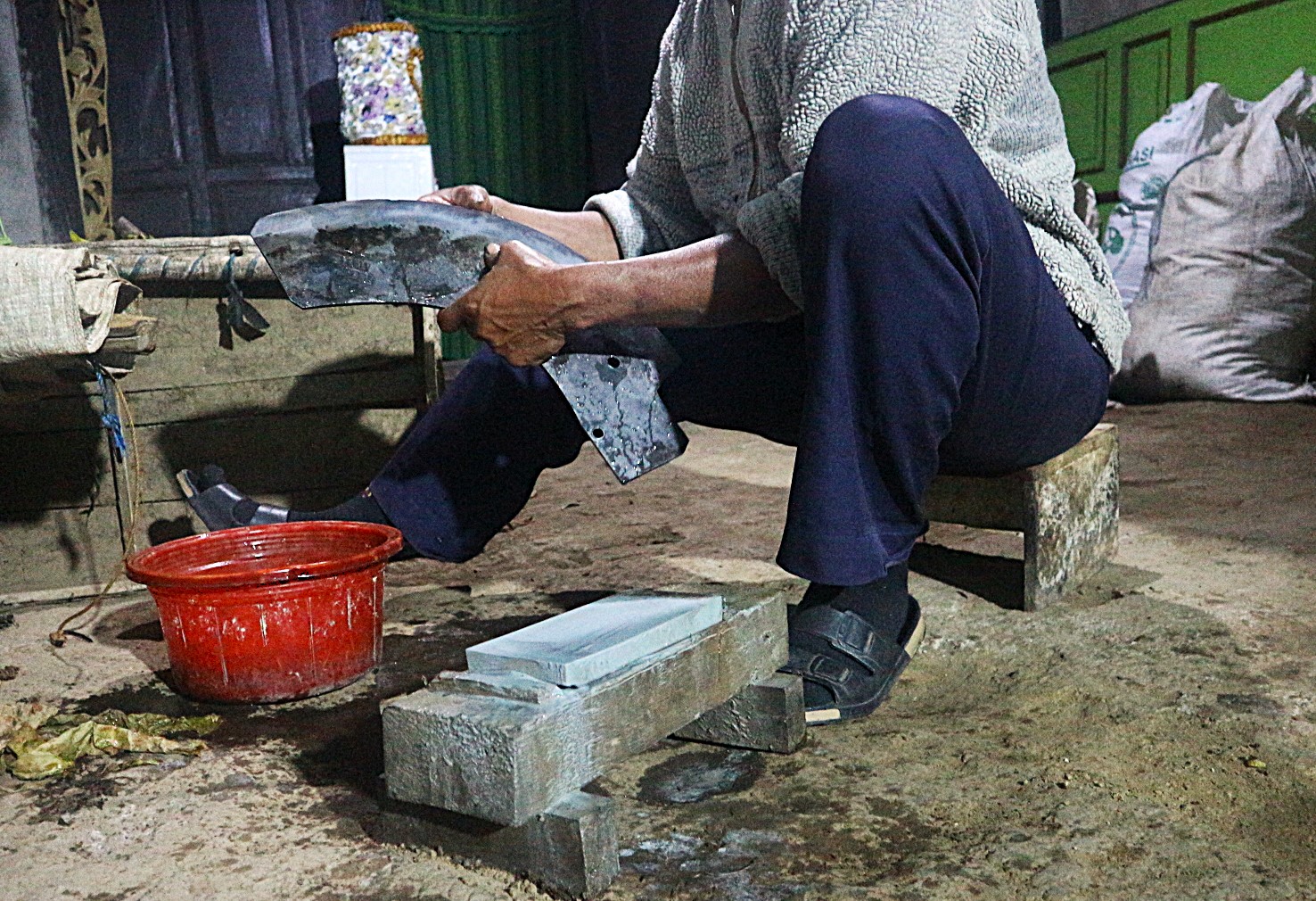
At night, when the day has grown quiet, a man in Ngaduman sits with a simple tool in his hands: a stone for sharpening a grass-cutting knife.
His hand moves back and forth, again and again. Then he turns the blade and repeats the same movement on the other side.
There is nothing hurried about it. Nothing complicated.
Yet in this simple repetition lies something of the way life in Ngaduman is kept in balance.
To understand Ngaduman is to notice these small, necessary acts.
The people here live through a rhythm in which everyday tasks are not easily separated from one another. Each has its place, and when one is left undone, something else may be affected.
Morning is for energy. Midday offers a pause. And in the afternoon, tiredness can be enjoyed rather than resisted, sitting in front of the fire, warming the body, drinking something warm, and talking.
These conversations are more than passing words. They become a kind of journaling of the day: what has been done, what has not yet been finished, and how something might be completed more effectively.
Life in Ngaduman is a form of order.
As members of the community, people remain closely connected to the needs of others. When one neighbour has a hajat, that becomes something to be prioritised. Personal routines can make room for the needs of the community.
And then there is the night. It is not simply a time to let the day disappear. It can be a moment to sharpen something.
The grass-cutting knife is sharpened manually with a whetstone. The hand moves repeatedly across one side of the blade, then turns it over and repeats the movement on the other.
The repetition is simple, but purposeful.
The sharpness that comes from it will help cut the grass that becomes part of the daily life of their goats and cattle. In this way, even a small act of maintenance belongs to a much larger rhythm of living.
Perhaps this is what makes the ordinary life of Ngaduman worth noticing.
The knife is not simply a tool. The whetstone is not merely something used to fill an evening.
The repeated movement offers a quiet reminder: sharpness is not always meant for oneself.
A blade must be sharpened so that something else can continue.
The same seems true of the rhythm of life here. Work is done because other things depend on it. Time is made for neighbours because community cannot simply be ignored. A conversation at the end of the day becomes a way to look back, evaluate what has happened, and consider what still needs to be done.
Life becomes balanced through these small acts of attention.
Sabato Kaliwuan, A Delightful Companion for Your Journey.
More than a curated travel experience, Sabato Kaliwuan is your access to authentic villages, meaningful encounters, and local stories that reveal Central Java beyond sightseeing. Through conversations with the people who shape village life, every journey becomes an opportunity to understand how villages are adapting, preserving their heritage, and creating new futures.
Perhaps one evening you will sit nearby as the stone moves slowly against the blade.
Perhaps you'll notice that nothing spectacular is happening.
There is only a hand, a knife, a stone, and the quiet rhythm of repetition.
And perhaps, after watching for a while, you may begin to see that this simple act is telling you something about how life in Ngaduman is lived.
Sabato Kaliwuan opens the door for travellers to come closer to the everyday life of this village on the slopes of Mount Merbabu.
Sabato Kaliwuan does not turn these moments into an itinerary. It creates access to the people, rhythms, and stories that are already there, allowing travellers to encounter village life through what people actually do, rather than simply through what a destination is known for.
A life does not always need to move faster to become better.
Sometimes it needs to be maintained. Sometimes it needs to be sharpened.
And sometimes, like the knife in the quiet of Ngaduman's night, it simply needs the patience to repeat what matters.