
The Memory of Kotagede, Baked One Morning at a Time
In Kotagede, Yogyakarta slowing down means looking beyond its historic streets and buildings to the people who keep its cultural memory alive. In the kitchen of Bu Galih, the making of Kembang Waru bread reveals how heritage survives through ordinary routines: walking to the market, preparing ingredients by hand, and tending a traditional oven with patience. Here, the past is not merely preserved; it continues to take shape in everyday life.
Morning sounds travel through the narrow alleys of Kotagede, where houses stand close together and daily life begins behind familiar doorways. From Bu Galih's kitchen comes the scent of Kembang Waru bread, slowly baking in a traditional oven over glowing charcoal.
Kotagede is widely known for its historic legacy, silver craftsmanship, and batik. Yet another part of its identity lives in a small, flower-shaped bread whose gentle sweetness and savoury aroma have long been familiar to the local community. Its story is not found only in historical accounts or old buildings, but also in the kitchens where people continue to make it by hand.
There is something quietly revealing about spending a morning here. Rather than simply seeing Kotagede's past, travellers can begin to understand how its heritage remains part of the present.
Bu Galih is one of the people who keep this culinary tradition alive. Her kitchen is not a large production space filled with modern machinery. Instead, it is a familiar working environment shaped by well-used utensils, practiced hands, and a method of baking passed down through generations.
The morning begins with a simple walk to the market. Travelling alongside Bu Galih to buy flour and eggs offers a glimpse into a routine she has followed for years. The market is not a special destination on her daily map; it is part of the rhythm of her life, reached on foot through the neighbourhood's narrow lanes.
Back in the kitchen, the ingredients are prepared. Flour, eggs, sugar, vanilla, and butter come together under her hands. Nothing about the process needs to be hurried. Each movement follows a familiar sequence, guided by experience rather than the instructions of a machine.
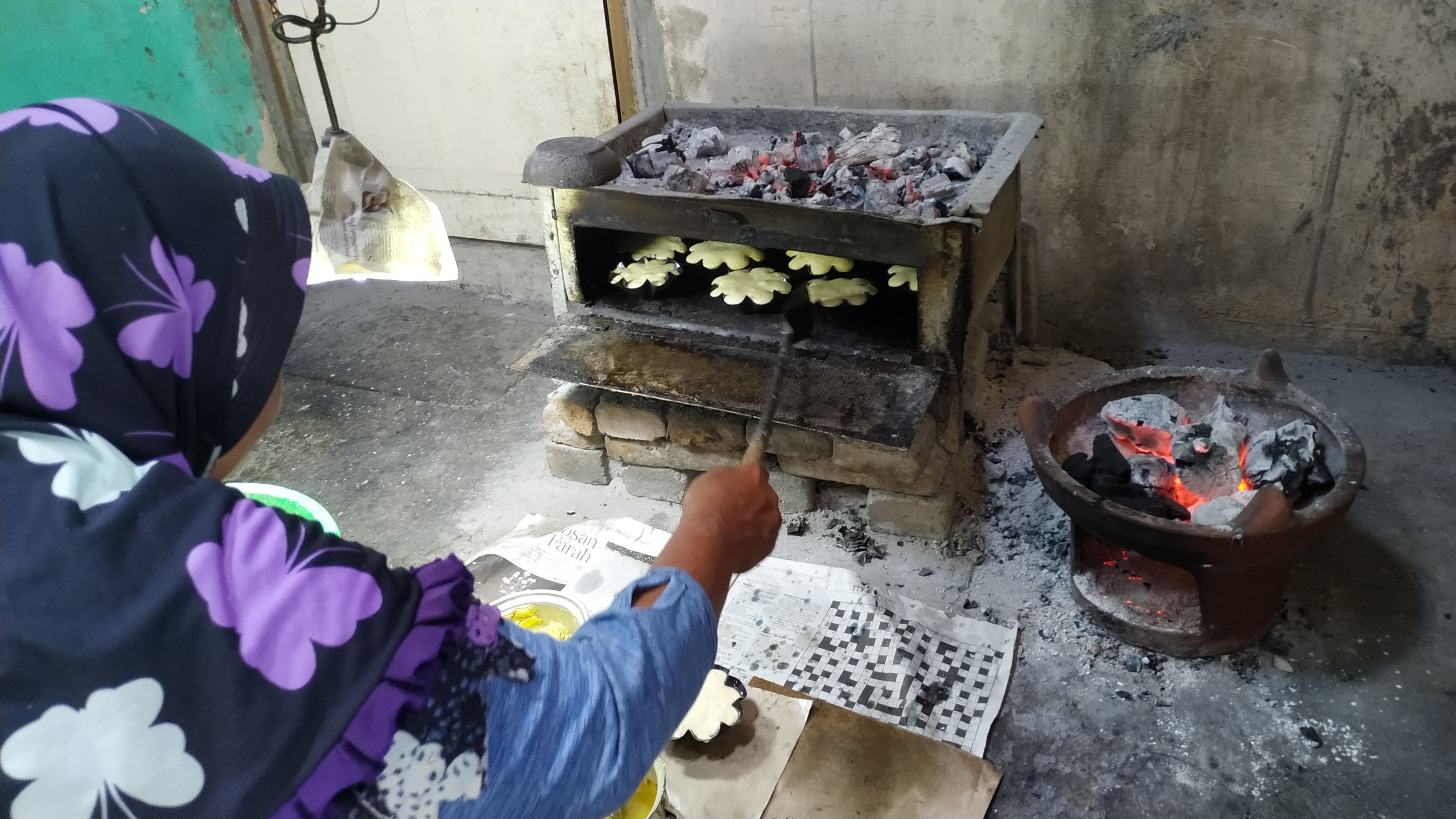
Once the charcoal has turned into glowing embers, Bu Galih distributes it across the top and beneath the traditional oven to create an even heat. Aluminium moulds shaped like waru flower petals are prepared, each brushed with butter before the batter is poured inside.
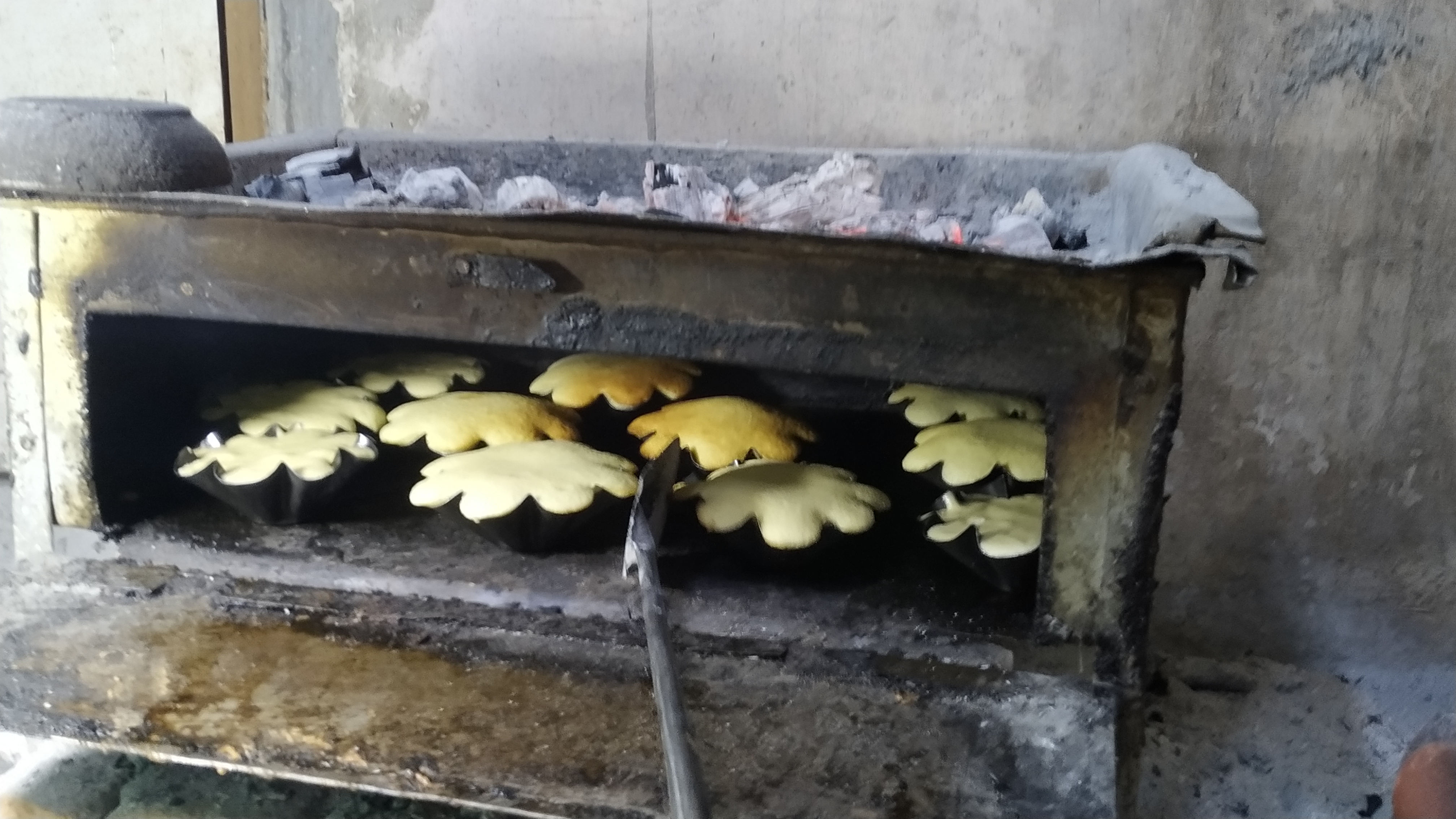
The filled moulds are then placed into the oven one by one. Within moments, the kitchen begins to fill with a warm, sweet aroma. The batter rises, and its surface gradually turns golden brown.
Yet baking Kembang Waru bread is not simply a matter of waiting for it to cook. Bu Galih carefully rotates the moulds, moves those inside the oven, and shifts others into different positions so that the heat reaches each one evenly. Using a metal spatula with a wooden handle, she handles the moulds with practiced precision.
Every movement serves a purpose. What might appear to an unfamiliar observer as a simple sequence of tasks is, in fact, a skill developed through years of repetition. Her hands seem to know when a mould needs to be moved and when the bread is ready, revealing a kind of knowledge that grows through doing.
After approximately twenty minutes, the bread is ready to be removed from the oven. Bu Galih lifts out the moulds with her long spatula, brushes the surfaces with butter, and carefully releases the finished bread.
The best moment comes when the Kembang Waru bread is still warm. Its soft texture, rich aroma, and gentle sweetness make it tempting to reach for another piece. But the experience offers more than the pleasure of tasting a traditional delicacy. Behind each bite lies a process shaped by time, familiarity, and the decision to keep doing things in a way that has endured.
The origins of Kembang Waru bread are often associated with the era of the Islamic Mataram Kingdom, although the identity of its first creator remains uncertain. Over time, the bread has become associated with celebrations and cultural occasions, taking its place in Kotagede's culinary heritage.
Its history, however, does not live only in accounts of the past. It continues in the everyday work of people like Bu Galih, who keep the familiar process alive each morning.
Cultural heritage is often encountered through monuments, historic buildings, and formal preservation efforts. These offer important ways to understand the past, but they are only part of the story.
In Kotagede, the making of Kembang Waru bread reveals another dimension of preservation: the quiet continuity of everyday life. A walk to the market, the preparation of familiar ingredients, the crackling of charcoal, and the careful handling of traditional moulds all contribute to keeping a local tradition present and meaningful.
This is where the significance of Bu Galih's work becomes clear. The bread is not simply an object inherited from an earlier generation. Its continued existence depends on someone choosing to make it, again and again, through skills learned and practised over time.
For travellers, being present in this kitchen offers a different way of understanding Kotagede. Rather than treating heritage as something confined to the past, they can witness how it remains woven into the lives of the people who live here.
Sometimes, understanding a place begins not with looking at what has survived, but with noticing who continues to keep it alive.
Perhaps one morning, you will find yourself walking through Kotagede's narrow alleys alongside Bu Galih, following her familiar route to the market before returning to the warmth of her kitchen.
You may find yourself listening to the crackle of charcoal, watching her hands move between the moulds, or waiting quietly as the aroma of freshly baked bread fills the room. And when a warm piece of Kembang Waru bread is finally placed before you, its taste may carry a meaning that goes beyond its ingredients.
You will have encountered not only a traditional delicacy, but also a small part of the life that sustains Kotagede's cultural memory.
Sabato Kaliwuan opens the door to encounters that allow travellers to understand a destination through the people who give it meaning.
In Kotagede, this means creating access to the everyday world of someone like Bu Galih, where a traditional baking practice becomes a way to discover the relationship between food, memory, and local life.
Sabato Kaliwuan acts as a mediator and storyteller, connecting travellers with experiences that may otherwise remain beyond the view of those passing through. Rather than turning an ordinary morning into a scheduled attraction, Sabato Kaliwuan helps make space for observation, conversation, and a more personal understanding of the community.
The value lies not in how many activities take place, but in what travellers come to understand through the encounter.
Sabato Kaliwuan, A Delightful Companion for Your Journey.
More than a curated travel experience, Sabato Kaliwuan is an access point to authentic villages, meaningful encounters, and local stories that reveal the face of Central Java beyond its destinations. Through conversations with coffee farmers, local fishermen, artisans, and those building their communities, every journey becomes an opportunity to understand how villages continue to adapt, preserve their cultural heritage, and create new futures.
As the morning passes, the charcoal gradually loses its glow, the freshly baked bread leaves the oven, and the familiar sounds of the kitchen settle back into the rhythm of the household.
Outside, Kotagede continues with its daily life. Inside, a tradition has been carried forward through a series of ordinary gestures, repeated with care and shaped by experience.
Perhaps this is one of the quieter lessons of travelling slowly here: history does not always announce itself through grand architecture or celebrated landmarks. Sometimes, it reveals itself through the hands of someone preparing breakfast, the familiar walk to a neighbourhood market, or the aroma of bread escaping through an open kitchen window.
To understand Kotagede more deeply is to recognise that its heritage is not only something to be seen. It is something people continue to live.