
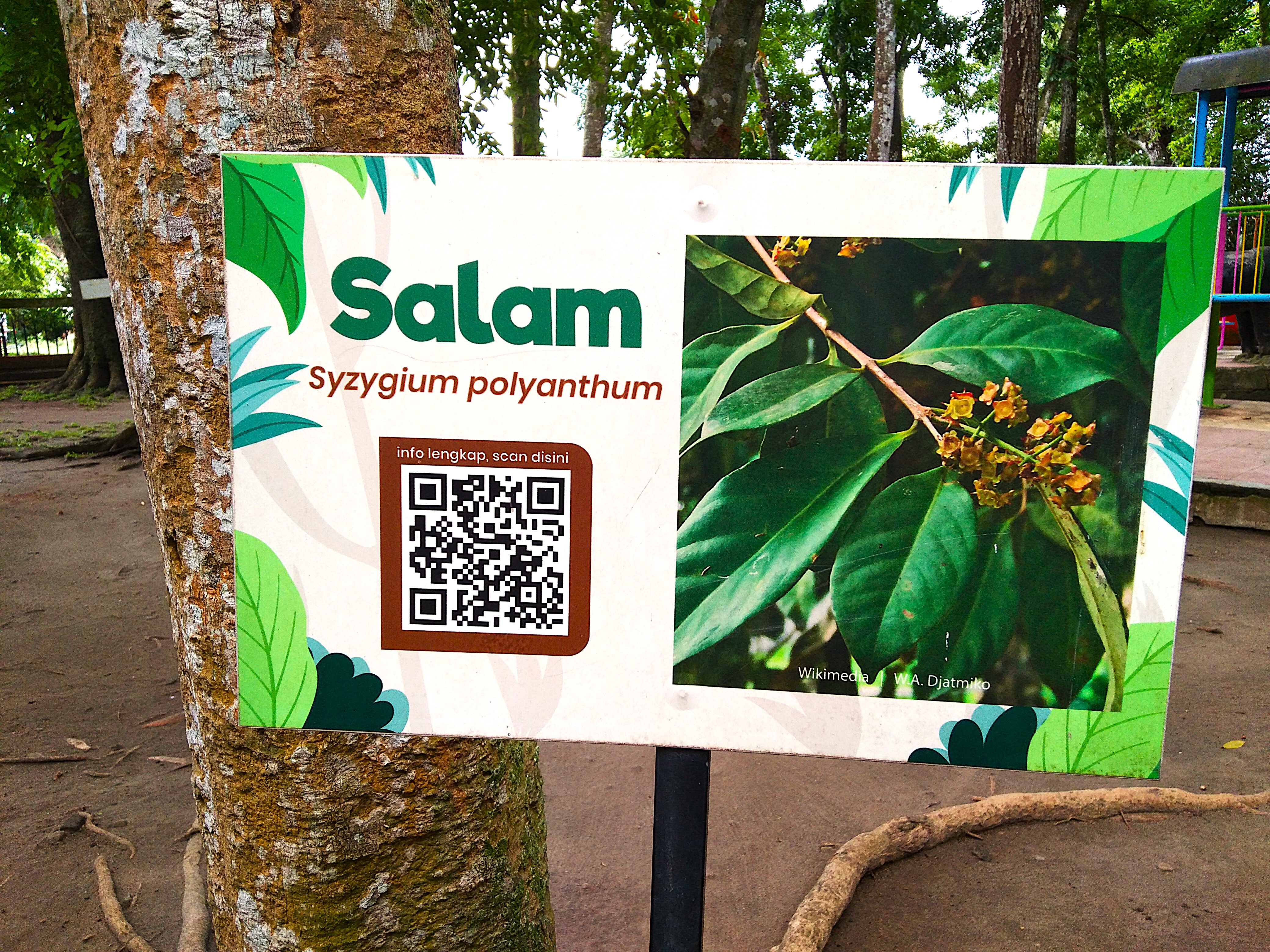
Kebon Rojo: A Salam Tree That Rises, a History That Grows
Within Kebon Rojo, Blitar’s public garden, a small sign stands quietly at the foot of a towering tree:
the Salam Tree (Syzygium polyanthum).
A simple name, familiar in kitchens across the Indonesian archipelago, yet one that carries a long journey of knowledge and history.
This salam tree grows tall because it is protected. Its trunk stands upright, its leaves dense and generous, reminding us that it lives in a space conceived from the very beginning to nurture life. This is where Kebon Rojo began—not merely as a park, but as a botanical laboratory during the Dutch colonial era. A place where plants were observed, recorded, tested, and cultivated; where the soil of Blitar was studied with patient scientific care.
In that era, Kebon Rojo became a ground for experimentation: how spices grow, how trees adapt, how the tropical landscape holds potential not yet fully understood. From this botanical laboratory, knowledge slowly emerged—knowledge that made possible the development of plantations in Blitar and its surrounding regions: rubber, cloves, tea, coffee, and many other crops that would later shape the economic and cultural landscape of the area.
Today, Kebon Rojo has changed its face. It is no longer a closed laboratory, but a people’s park—a green space where residents take morning walks, children play, and visitors find shelter from the sun. Yet its spirit remains the same: to protect, to preserve, and to care. The Salam tree standing before us is living proof of this continuity—from colonial science to a shared awareness of the importance of conservation.
Beneath its canopy, we can imagine the past: botanists recording the growth of leaves, garden workers tending the soil, and slowly, the seeds of Blitar’s plantations finding their way. Today, those shadows blend with the unhurried footsteps of visitors, with laughter, and with the steady breath of a city moving forward.
For travelers arriving in Blitar, Sabato Kaliwuan—A Delightful Companion for Your Journey—offers a more personal telling of Kebon Rojo’s history, revealing that the garden is more than a green space. It invites us to understand that history is not always written in stone or embodied in grand monuments—sometimes it grows quietly, takes root deeply, and rises slowly, just like this Salam tree.
Stand together for a moment beneath the Salam Tree’s nameplate, and feel how Blitar tends to its memories—of spices, of soil, and of a future rooted in nature, cared for with mindful intention.