
Beyond the Visit: When a Coffee Farmer’s Home Becomes a Place to Pause
In Blitar, the journey to Sumberurip Village is not simply about leaving the city's bustle behind. It is about making room for encounters that do not follow a tight schedule. At a coffee farmer’s home, a pause takes shape through simple moments: sitting together, sharing local snacks, and listening to stories of everyday life. Here, the journey slows not only because the road winds through the countryside, but because the people you meet give you a reason to stay a little longer.
Blitar does not have to be a place to pass through on the way somewhere else. It can also be a place to pause before gradually finding a different rhythm of life.
From the Sabato Kaliwuan host’s home, the journey continues by car. Without a packed itinerary, the road leads from one place to pause to the next. The traffic that once filled the view gradually gives way to stretches of green along the western foothills of Mount Kawi.
After roughly an hour, travellers arrive in Sumberurip Village. The road isn't particularly steep, but its curves follow the contours of the rural, mountainous landscape, bringing them closer to the everyday lives of the coffee farmers who call this place home.
Yet the most meaningful change is not simply in the scenery. The journey begins to feel less like travelling towards a destination and more like an opportunity to get to know the people who live there.
Upon arriving in Sumberurip, travellers are welcomed outside the home of Mas Ipnu, one of the village’s young coffee farmers.
The cool mountain air meets the warmth of a genuine welcome. Mas Ipnu and his family greet their visitors with a gesture familiar in Javanese culture: a slight bow, an outstretched hand, and a handshake that conveys openness and respect.
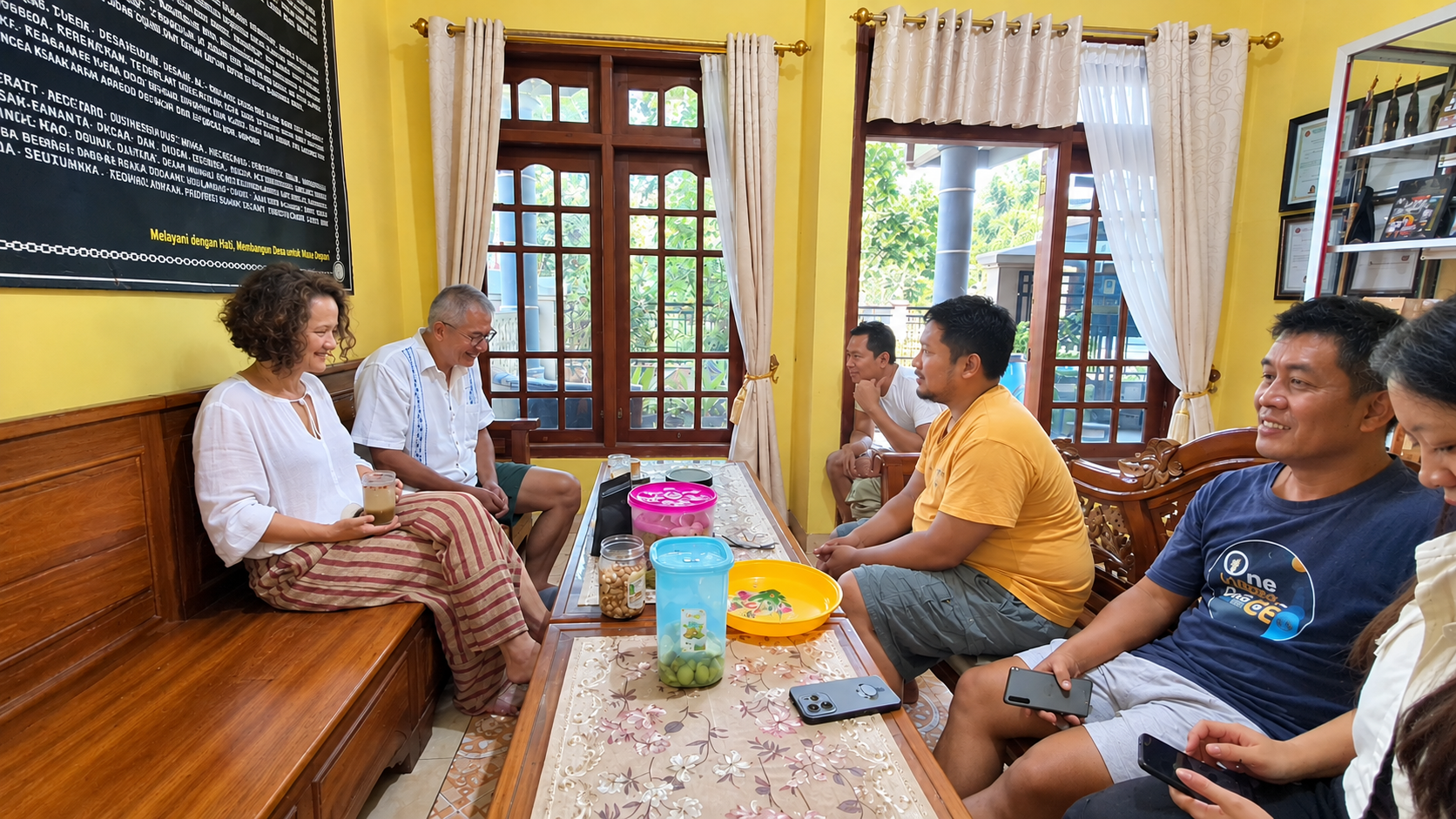
After introductions, Mas Ipnu and his family invite the travellers inside to sit in their simple living room. The atmosphere gradually softens the distance between host and guest. It feels less like visiting strangers and more like being a distant relative who has finally come home for a visit.
Here, hospitality is not something staged for an audience. It emerges through a welcome, a conversation, and the willingness to share time with someone new.
The living room soon becomes a setting for gupuh, lungguh, suguh, a Javanese expression of hospitality that involves welcoming a visitor, inviting them to sit, and offering refreshments as a gesture of respect.
Local village snacks are laid out on the table. Mas Ipnu’s parents join the gathering, while the Sabato Kaliwuan host accompanies the travellers as a companion and a bridge into local life. What might initially feel like an unfamiliar encounter soon becomes a relaxed conversation.
In everyday life in Blitar, this kind of informal gathering is known as jagongan. There is no technical discussion about how coffee plants are cultivated, nor a formal conversation about farming. Instead, stories unfold naturally, occasionally interrupted by laughter.
With a light in his eyes, Mas Ipnu talks about how he and other young farmers in Sumberurip devote their time and energy to caring for their coffee trees. Other family members occasionally add their thoughts. Through these simple exchanges, it becomes clear that coffee and spices mean more to them than the crops they grow and sell.
They are woven into family life, daily work, and bonds passed down through generations. For these young farmers, tending their plants is also a way of maintaining a longstanding relationship between people and the natural world.
Not every story needs a lengthy explanation. Some things become clearer simply by sitting together, listening, and allowing people to share their lives in their own words.
A home is not defined by its building alone, but by the people who welcome us inside.
A visit to Mas Ipnu’s home offers another way to understand luxury. It does not have to take the form of a five-star hotel or exceptional service. Sometimes, luxury is found in someone opening their door, offering a seat, serving simple refreshments, and sharing stories without making their guests feel like outsiders.
The lives of Sumberurip’s young farmers also invite us to see their work from a different perspective. Behind the coffee trees and spices are the time, thought, and care they invest in their relationship with the land. There are also family bonds and inherited ways of life that continue to hold meaning for the next generation.
An experience like this may not always produce a dramatic photograph. Yet it offers something a camera cannot easily capture: an understanding of people, the values they preserve, and the ways they live their everyday lives.
Perhaps one day, you will travel from Blitar to Sumberurip without feeling the need to visit as many places as possible in a single day.
Perhaps you will find yourself sitting in Mas Ipnu’s living room, enjoying local snacks, listening to stories about the coffee trees, and laughing with a family you have only just met.
You may arrive as a traveller hoping to discover a village. But through a simple conversation, you may find that a journey does not become meaningful because of the number of places you visit. Sometimes, its meaning grows when you are given the space to sit down, listen, and feel welcome.
Sabato Kaliwuan creates access to encounters like these, connecting travellers with the everyday lives of local communities through personal, story-led experiences.
On the journey to Sumberurip, Sabato Kaliwuan is more than a connection between one place and another. As a delightful companion, Sabato Kaliwuan accompanies travellers into the everyday spaces of local life, helps open conversations, and makes room for human connections to develop naturally.
Because getting to know a place does not always begin with seeing more. Sometimes, it begins by taking the time to know someone who lives there.
Sabato Kaliwuan, A Delightful Companion for Your Journey.
More than a curated travel experience, Sabato Kaliwuan is your access to authentic villages, meaningful encounters, and local stories that reveal East Java beyond sightseeing. Through conversations with the people who shape village life, every journey becomes an opportunity to understand how villages are adapting, preserving their heritage, and creating new futures.
What makes a visit different from simply arriving and leaving?
Perhaps the answer lies in the willingness to slow down and recognise that local life is not a performance prepared for travellers. It is real life, shaped by work, family relationships, everyday customs, and values that continue to guide the people who live it.
When we make room for conversation and listen without rushing, a simple home can become a place to understand something larger than a destination: how people nurture relationships, preserve their heritage, and welcome others into their world.
Tag: adventure, batik, blitar, blitarstopover, bromo, coffe, culture, eastjava, ecotourism, familytravelers, indonesiaspicingtheworlds, local, malang, nature, redefineluxury, sabatokaliwuanvibes, slowblitar, slowtravel, spice, traditional, train