
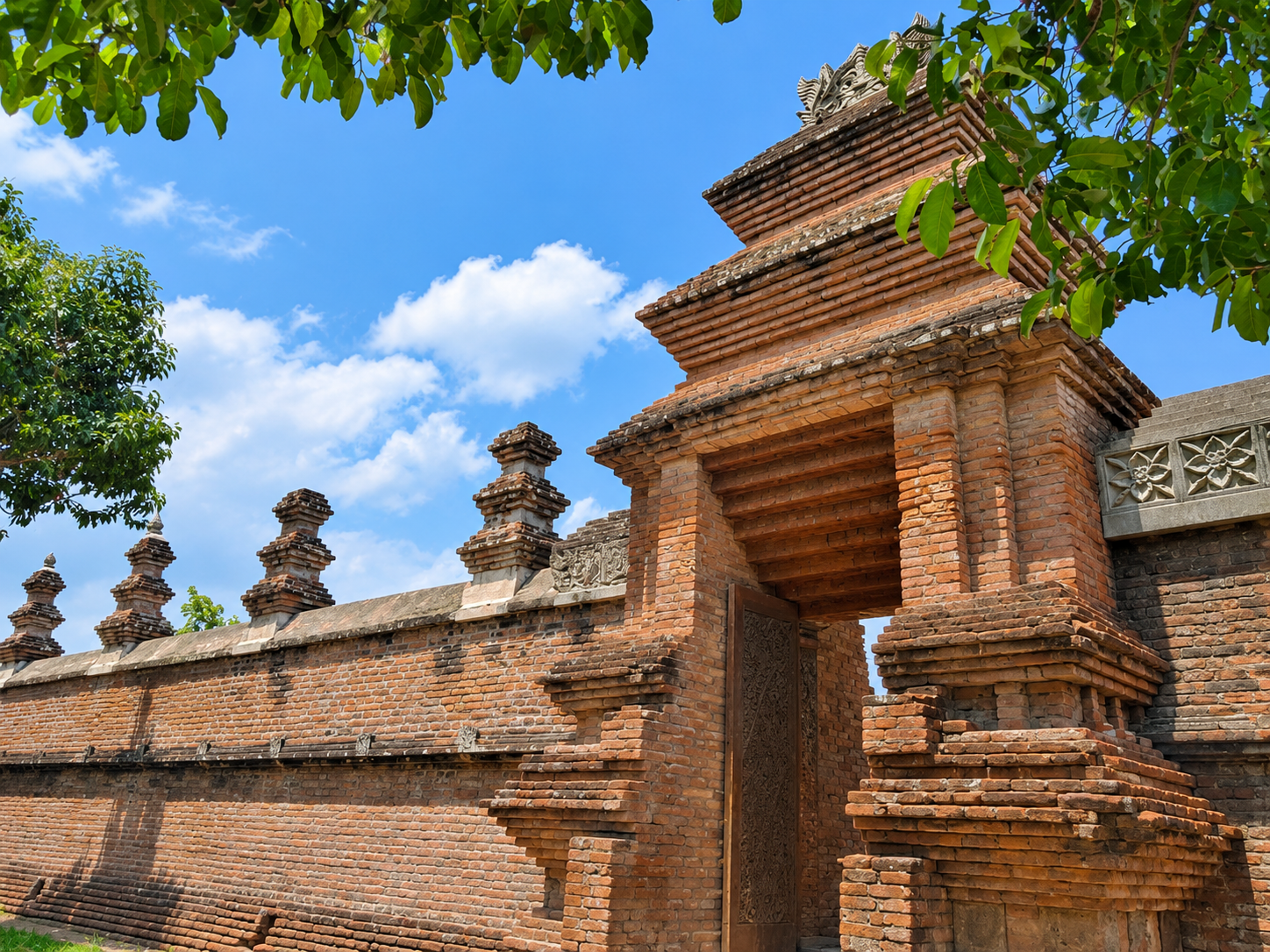
Beyond the Red Brick Walls: Discovering the Quiet Harmony of Kotagede
At the Great Mosque of Mataram in Kotagede, Yogyakarta slowing down means looking beyond the architecture to the relationship between cultural heritage, faith, and everyday life. Beneath the shade of the courtyard trees, travellers can step away from the rush of a packed itinerary and pay attention to the details that tell a deeper story. Here, the experience lies in taking time to observe, reflect, and discover how different cultural influences have become part of Kotagede's enduring identity.
A walk through the narrow alleys of Kotagede eventually leads to the red-brick walls of the Great Mosque of Mataram. Beyond them, the atmosphere begins to change. A spacious courtyard rests beneath the shade of mature trees, a gentle breeze moves through the leaves, and traditional Javanese architecture stands quietly against the passage of time.
Within the complex, pools used for washing the feet before entering the mosque courtyard form part of the approach to this sacred space. Travellers can pause beneath the trees, feel the breeze against their skin, and let their eyes wander across the old walls and architectural details that have endured through generations.
There is no need to hurry towards the next destination. A moment spent sitting beneath the trees or observing the building can become an experience in itself. Rather than moving quickly from one landmark to another, travellers are invited to notice what might otherwise escape their attention.
At the Great Mosque of Mataram, the experience extends beyond the building to the people whose lives and faith give the place its meaning. A mosque is more than an arrangement of bricks, timber, and supporting pillars. It is a living space where religious practices continue, memories are passed down, and the relationship between a community and its history can be felt.
For travellers arriving from outside Kotagede, spending time here offers an opportunity to approach the mosque with greater sensitivity. Instead of viewing it simply as a historic monument, they can begin to recognise its place in the life of the local community.
Sometimes, understanding a place begins with observing how people relate to it: the respect shown towards a sacred space, the quietness that accompanies prayer, and the everyday rhythms that continue around its historic walls.
The red-brick walls surrounding the Great Mosque of Mataram preserve traces of different cultural traditions. Architectural features and decorative motifs associated with Hindu-Buddhist traditions can be found alongside the mosque's identity as a place of Islamic worship. Their coexistence offers a glimpse into the cultural influences that have shaped this historic setting.
The mosque's history is associated with the founders of the Islamic Mataram Kingdom. Its architectural character reflects a relationship between Islamic religious life and Javanese cultural traditions, revealing how a place of worship can also carry traces of the society in which it developed.
As travellers look more closely, their attention may settle on details that are easy to overlook at first glance: ancient carvings, calligraphy, the pillars supporting the roof, or the shifting shadows cast across the old walls.
These details do not tell the entire story on their own. Yet they invite questions about how cultural traditions are preserved, how architectural forms acquire meaning, and how the past continues to shape the way people experience a place today.
Understanding such a heritage does not require every question to be answered at once. Sometimes, a quiet moment of observation is enough to begin a deeper conversation with history.
Why It Matters
Historic buildings are often appreciated for their age, architectural beauty, or significance in the past. Yet their meaning can extend far beyond what the eye can see.
At the Great Mosque of Mataram, the relationship between Javanese architecture and Islamic religious life offers an opportunity to reflect on how cultural influences can coexist within a shared space. This does not mean that every difference disappears. Rather, the building encourages us to consider how different traditions can become part of a place's identity without losing their distinctiveness.
For travellers, this perspective offers an alternative to simply collecting photographs of historic landmarks. It encourages a more thoughtful encounter with the stories, values, and cultural expressions that have shaped Kotagede.
The experience becomes less about identifying every architectural feature and more about learning to look with curiosity and humility.
Sometimes, the deeper meaning of a place emerges not from what we immediately recognise, but from the questions we begin to ask when we allow ourselves to stay a little longer.
Perhaps one afternoon, you will walk through Kotagede's narrow alleys until the red-brick walls of the Great Mosque of Mataram appear before you.
You might pause beneath the trees, listen to the breeze moving through the courtyard, and take a closer look at the building's distinctive details. Perhaps a carving will hold your attention longer than expected, or the shadows on an old wall will prompt you to wonder about the generations who have passed through this place.
There is no need to understand everything in a single visit. You can simply be present, observe with care, and allow your curiosity to guide your thoughts.
Perhaps that is when Kotagede begins to reveal something beyond its architecture: a more personal understanding of how history, faith, and cultural memory remain woven into the life of a place.
Sabato Kaliwuan opens the door to a more personal understanding of Kotagede, connecting travellers with the stories and cultural meanings that lie beyond its historic landmarks.
At the Great Mosque of Mataram, Sabato Kaliwuan acts as a mediator and storyteller, helping travellers approach the relationship between architecture, heritage, and religious life with greater attention. The aim is not simply to direct the eye towards an old building, but to create space for questions, reflection, and a deeper appreciation of the community's cultural landscape.
Through this approach, Sabato Kaliwuan connects travellers with experiences that encourage them to look beyond appearances and discover the human stories behind a destination.
A meaningful encounter does not always require a packed schedule. Sometimes, it begins with a quiet courtyard, an architectural detail, and the willingness to understand what a place means to the people connected to it.
Sabato Kaliwuan, A Delightful Companion for Your Journey.
More than a curated travel experience, Sabato Kaliwuan is an access point to authentic villages, meaningful encounters, and local stories that reveal the face of Central Java beyond its destinations. Through conversations with coffee farmers, local fishermen, artisans, and those building their communities, every journey becomes an opportunity to understand how villages continue to adapt, preserve their cultural heritage, and create new futures.
Behind the red-brick walls of the Great Mosque of Mataram, tranquillity does not mean an absence of stories. Within the shaded courtyard, the building's historical traces, cultural influences, and religious significance offer opportunities for reflection.
Kotagede reminds us that a journey does not always become richer by moving towards the next destination. Sometimes, we discover more when we stop walking and begin paying closer attention.
Perhaps this is what makes a historic place meaningful to travellers today. Beyond its age and architectural character, it offers a chance to reflect on the relationship between the past and the lives people continue to lead.
When you eventually leave the courtyard, you may carry more than a memory of an old building. You may leave with a question that stays with you: how can we better understand our differences, respect the heritage we inherit, and live alongside one another?