
Before the Day Begins, There Is a Morning to Be Lived
Golden morning light slowly appears from behind the hills that conceal the peak of Mount Merbabu.
Its first rays begin to warm Ngaduman Village, the traditional wooden houses, the grass, the flowers, and the plants growing in the gardens. From a small path beside the houses, the voices of children saying goodbye before leaving for school can be heard.
The village is slowly waking up.
But for Pak Barji, morning does not always have to begin with work.
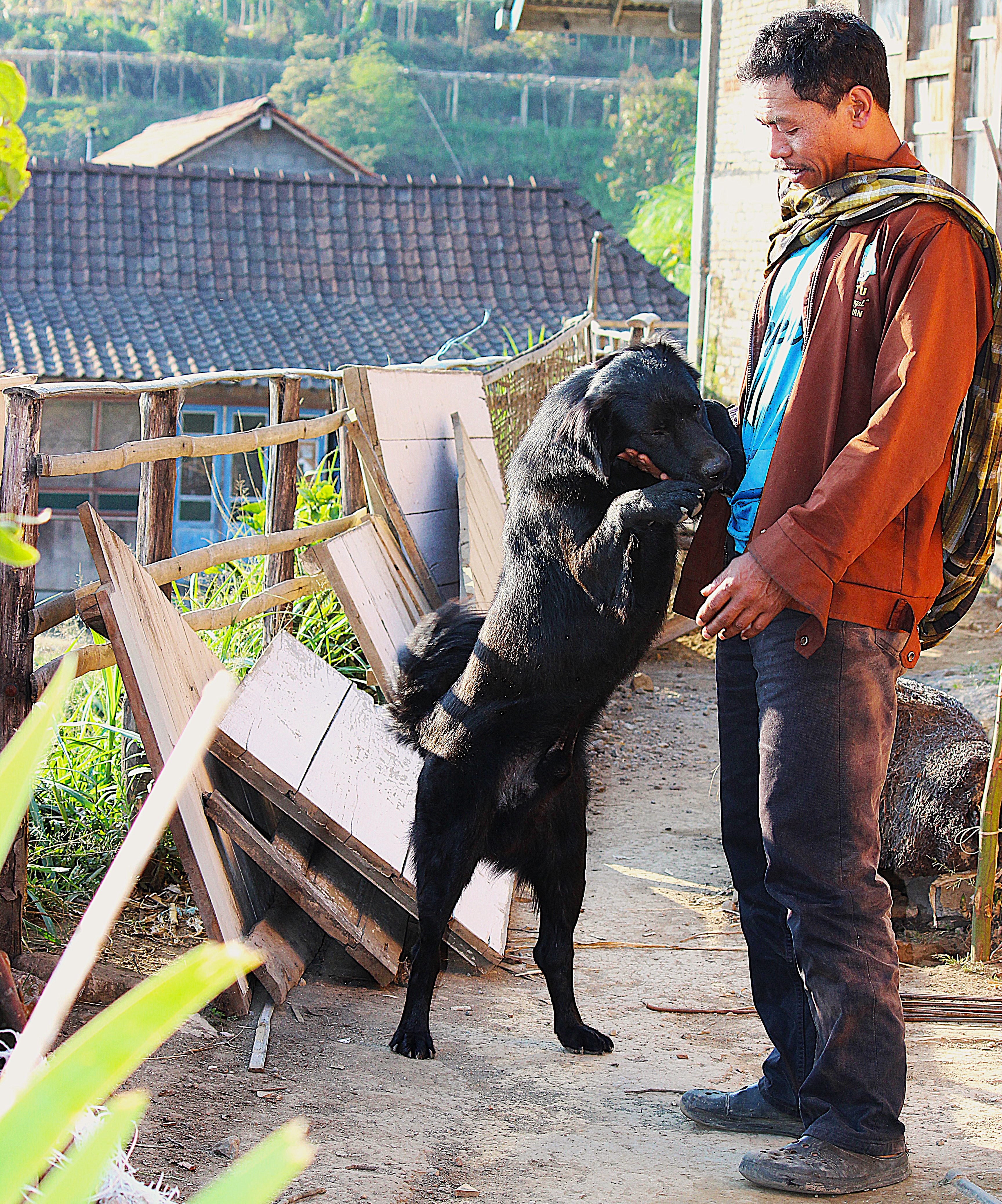
Before starting his day, he takes a few moments to greet his animals in his own way. It is a simple moment, perhaps ordinary at first glance, yet one that seems to hold a quiet meaning for him.
Morning becomes a time to simply be present, to express something through gestures, expressions, and a few quiet moments shared with an animal that has become part of his everyday life.
Not every moment at home or in the garden has to be about work.
Whatever he wears, a sarong almost always rests across Pak Barji's shoulders.
That morning, together with his animal companion, he warms himself in the gentle morning sunlight.
The animal barks, runs towards him, and wags its tail. Then it stands before Pak Barji, as if trying to say something understood only by the two of them.
Pak Barji opens his palm.
The animal moves closer, almost as if to smell his hand.
Pak Barji's face and smile are as warm as the morning light slowly reaching the houses and gardens around them.
There is no long conversation.
Nothing needs to be explained.
Just a small encounter between a man and an animal that has become part of his everyday life.
Once morning has arrived, the gardens with their different crops are waiting for Pak Barji.
But his gardens are not all in one place.
The vegetable garden lies a few metres from his home, along an uphill road. His Arabica coffee garden is to the east of the house, only about 100 metres away.
His days move between these small spaces.
Home.
The uphill road.
The vegetable garden.
The coffee garden.
Everything is close, yet each place holds its own rhythm and its own work waiting to be done.
Morning in Ngaduman feels like a kind of warmth slowly spreading through the village.
The sunlight falls gently across the landscape. Green plants fill the view. The air feels fresh beneath a clear sky. Green hills stretch beneath the blue, while the houses of the villagers, painted in different colours, stand among them.
Traditional houses and more modern buildings blend into the same landscape, sheltered beneath the same sky and surrounded by green.
For travellers whose mood is easily shaped by the weather, a morning like this offers a reason not to move on too quickly.
You can pause.
Look at the traditional houses.
Notice the modern buildings standing alongside them.
Hear the children leaving for school.
Feel the morning air.
And simply allow time to pass without immediately needing to find something to do.
Perhaps what makes a place feel close is not what it possesses, but the opportunity to see the life unfolding within it.
Morning in Ngaduman reveals this through very simple things.
A man greeting his animal before work.
Children saying goodbye before leaving for school.
Houses beginning their day beneath the morning light.
Gardens waiting to be tended.
Nothing seems extraordinary when seen only in passing.
But when we slow down, these simple moments begin to speak.
We begin to see that life does not always have to begin with busyness.
Sometimes, it begins by greeting someone, or an animal, we care about.
Sometimes, it begins by sitting for a while and letting the morning sun warm us.
And perhaps that is when a place slowly stops feeling like somewhere we are visiting.
It begins to feel like home.
Perhaps one morning, you will find yourself in Ngaduman before the day has truly begun.
Perhaps you will see Pak Barji greeting his animal, hear children saying goodbye before school, or simply stand near one of the houses as sunlight slowly reaches the hills and gardens.
You do not need to hurry towards somewhere else.
Perhaps it is enough to pause.
Let the morning unfold in its own way.
And perhaps, without noticing exactly when it happens, Ngaduman will no longer feel like a place you are visiting.
It will begin to feel like home.
Sabato Kaliwuan creates access to moments that might otherwise pass unnoticed.
Sabato Kaliwuan connects travellers with local people and opens the door to the everyday rhythms of Ngaduman, not through a predetermined itinerary, but through encounters that allow a place to reveal itself slowly.
Through encounters with people like Pak Barji, travellers can begin to see that a village is not simply made of gardens, houses, hills, or scenery.
Relationships are unfolding within it.
Small daily rituals.
Conversations without words.
A life that simply continues.
Sabato Kaliwuan acts as a mediator, storyteller, and delightful companion, helping travellers come closer, stay a little longer, and understand before simply seeing.
Sabato Kaliwuan, A Delightful Companion for Your Journey
More than a curated travel experience, Sabato Kaliwuan is your access to authentic villages, meaningful encounters, and local stories that reveal Central Java beyond sightseeing. Through conversations with the people who shape village life, every journey becomes an opportunity to understand how villages are adapting, preserving their heritage, and creating new futures.
Perhaps we often think a journey begins when we leave home.
In Ngaduman, the morning offers another possibility: a journey can begin with something much simpler.
With a greeting. With paying attention.
With sitting for a while beneath the morning sun.
With watching how a man begins his day with his animal companion, how children say goodbye before school, and how a village slowly wakes.
Nothing needs to be chased. Nothing needs to be forced.
Simply be there.
Because sometimes, when we give a place enough time to speak in its own way, we do more than begin to know that place.
We begin to feel part of it.