
Batik Is Never in a Hurry. Why Should Your Journey Be?
The Slow Travel Perspective
In Blitar, slow travel finds its meaning when travellers stop chasing places and begin giving their time to a process. Batik teaches that every line begins with patience, every pattern grows through conversation, and every piece of cloth carries the traces of an encounter between local artisans and those willing to learn.
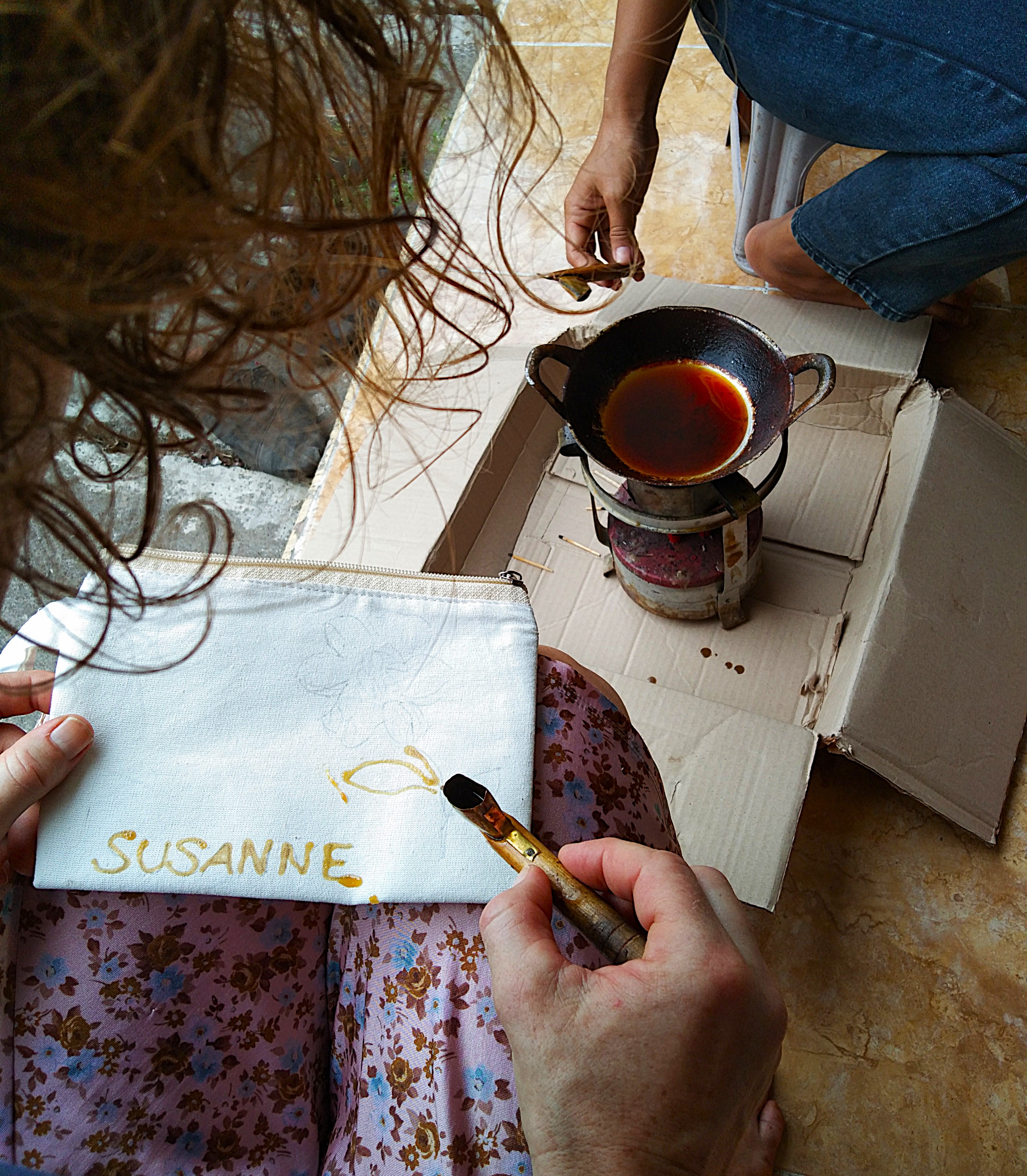
A pair of hands carefully holds a canting.
Hot wax flows slowly onto a piece of white cloth. Nothing moves in haste. Every line follows its own rhythm while a local artisan sits nearby, quietly observing before gently offering guidance.
No one asks you to finish quickly.
Inside the workshop, time seems to move at the same pace as the wax flowing from the tip of the canting.
For the artisan, this is a craft practiced for many years.
For a traveller, it may be the first time discovering that a journey can begin with a single piece of cloth.
The artisan does not begin by explaining batik techniques.
The conversation comes first.
About family.
About patterns passed down through generations.
About how a piece of cloth slowly gains meaning through the hands that create it.
Only after the conversation settles naturally does the canting find its way into your hands.
Many journeys across Java are filled with busy itineraries. Travellers move from one destination to another by road, checking digital maps, counting the remaining hours, and wondering when they will finally arrive.
Blitar offers a different rhythm.
This small city invites travellers to stay a little longer, meet local people, and become part of everyday cultural life.
One of those experiences is batik making.
Inside a local workshop, travellers do more than watch artisans at work. They sketch their own ideas with a pencil, transfer personal stories onto the fabric, and learn how to guide the canting under the patient supervision of local artisans.
The pattern is only a guide.
Everything else becomes a space for spontaneity.
Sometimes the wax falls where it was never intended. Sometimes the lines drift beyond the original sketch. The artisan never treats these moments as mistakes. Instead, they gently show how every unexpected mark can become part of the beauty of the final work.
Little by little, travellers realise they are not simply making batik.
They are leaving a part of themselves on the cloth.
Batik is never created in a hurry.
Neither are the journeys we remember most.
In a world shaped by packed itineraries, batik offers another way to experience time. Travellers stop thinking about the next destination and instead devote their attention to a single movement, a meaningful conversation, and a process that unfolds patiently.
In the end, what they take home is more than a piece of cloth.
They carry home the understanding that the finest work often begins the moment we stop rushing.
Perhaps one afternoon you will sit beside a local batik artisan, holding a canting for the very first time, smiling as a drop of hot wax lands outside the pattern you carefully sketched.
Perhaps, in that quiet moment, you will realise that the most beautiful lines are not the perfect ones, but those that remind you that you once shared your time, your curiosity, and your presence with the people of Blitar.
Sabato Kaliwuan creates access for travellers to experience the everyday lives of local batik artisans through genuine encounters.
Sabato Kaliwuan connects travellers with the people who continue to preserve the tradition of batik, allowing every line drawn on the cloth to become part of a shared story rather than simply a cultural activity.
Sabato Kaliwuan, A Delightful Companion for Your Journey.
More than a curated travel experience, Sabato Kaliwuan is your access to authentic villages, meaningful encounters, and local stories that reveal East Java beyond sightseeing. Through conversations with the people who shape village life, every journey becomes an opportunity to understand how villages are adapting, preserving their heritage, and creating new futures.
When the journey is over, you may forget how many hours it took to reach Blitar.
But your hands will remember what it felt like to hold a canting for the very first time.
And every time you unfold the batik you created, you will see more than patterns.
You will remember the conversations, the patience, the laughter, and the time shared with the people whose everyday lives continue to give this tradition its meaning.