
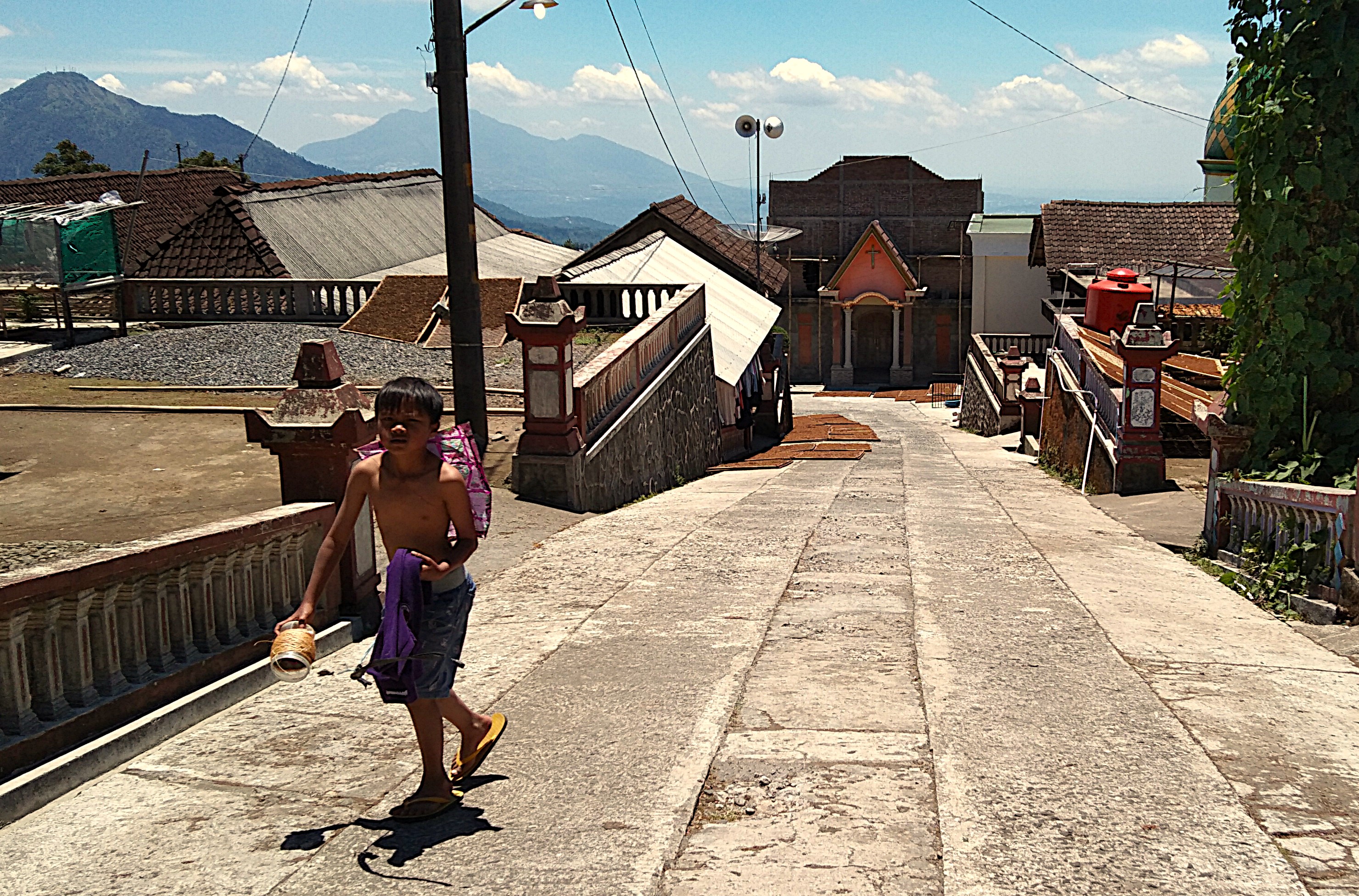
A Boy, a Kite, and the Walk Home That Reveals the Rhythm of Village Life
In Ngaduman Village, slow travel begins by noticing the ordinary moments that often go unseen. A child walking home, a kite carried by the afternoon breeze, and the quiet village roads travelled each day reveal the rhythm of local life. Through these simple moments, the village gradually introduces itself, not as a destination to be visited, but as a community to be understood.
A young boy walks home along a road that gently climbs the hillside. A kite hangs around his neck, while his right hand tightly holds the spool of string that has danced with the afternoon wind. Simple houses line both sides of the road, following the contours of the mountain slope. In the distance, Mount Merbabu rises quietly beneath a clear blue sky.
For those who call this village home, it is an ordinary afternoon. For a traveller, however, the boy's journey home becomes the first doorway into understanding life in Ngaduman.
Children in Ngaduman grow up without ever questioning the geography that surrounds them. The mountain is not a destination; it is simply part of everyday life. Fields become their playground, while narrow paths and open farmland offer endless space to explore.
During the dry season, flying kites becomes one of the simplest ways to spend time together. They read the direction of the wind without instruments, simply by watching the movement of the trees. Without gloves or protective gear, their fingers have long learned how to release and pull the string, keeping the kite dancing across the sky. If it loses control, it falls gently into the fields rather than disappearing into tall trees. Friends run to retrieve it, and within moments, it is soaring once again.
Ngaduman is a highland village where mist, farmland, and livestock shape everyday life. Rows of modest houses follow the winding roads, while traditional kitchens, still warmed by stoves, remain the heart of every home. During the dry season, the sun can be intense, yet the evenings quickly turn cold. When the rainy season arrives, mist quietly slips indoors like drifting smoke, carrying the cool mountain air with it, while the surrounding fields and gardens return to shades of vibrant green.
After playing, children rarely enter through the front door. Instead, they head directly to the pawon, the traditional kitchen. Gathered around the warmth of the firewood stove, they warm their bodies, enjoy a hot drink, and naturally become part of family conversations. Before the day ends, they visit the livestock shelter beside the kitchen, helping prepare fresh grass brought home from the fields.
This is the rhythm of life on the mountain slopes. Every walk to the fields is likely to pause for a conversation with neighbours. Twice each day, once in the morning and again after lunch, people return to their fields before coming home with harvested crops and bundles of fresh grass for their animals. Here, conversations are not interruptions to daily life; they are part of it.
In Ngaduman, children learn about nature not from classrooms, but from living alongside it every day. They learn to read the wind, understand the changing seasons, follow the rhythm of the fields, and grow within traditions quietly passed from one generation to the next.
Perhaps that is what makes a village more than a place.
It becomes a way of life.
Perhaps one afternoon you'll find yourself standing beside a village road, watching a young boy walk home with a kite hanging around his neck. As you quietly follow his footsteps, you may begin to realise that village life is never rushed. It moves with the rhythm of nature, conversations, and a sense of togetherness that has long been woven into life on the mountain slopes.
Perhaps what will stay with you the longest is not the mist that blankets Ngaduman, nor the quiet strength of Mount Merbabu.
Perhaps it is the image of a young boy walking home with a kite around his neck, reminding us that life's simplest moments often carry its deepest stories.
Sabato Kaliwuan, A Delightful Companion for Your Journey.
More than a curated travel experience, Sabato Kaliwuan is your access to authentic villages, meaningful encounters, and local stories that reveal Central Java beyond sightseeing. Through conversations with the people who shape village life, every journey becomes an opportunity to understand how villages are adapting, preserving their heritage, and creating new futures.